Do Callers Mind Talking to AI? What 2026 Surveys Say
What three 2026 consumer surveys say about AI phone agents and why their numbers seem to conflict, with a call design people accept.
On this page
- Key takeaways
- What do the 2026 surveys say?
- Why do the numbers seem to conflict?
- What do callers dislike more than AI?
- Should the agent say it is AI?
- What does an acceptable AI call sound like?
- How do you design for acceptance?
- How do you find out what your own callers think?
- Frequently asked questions
- Sources
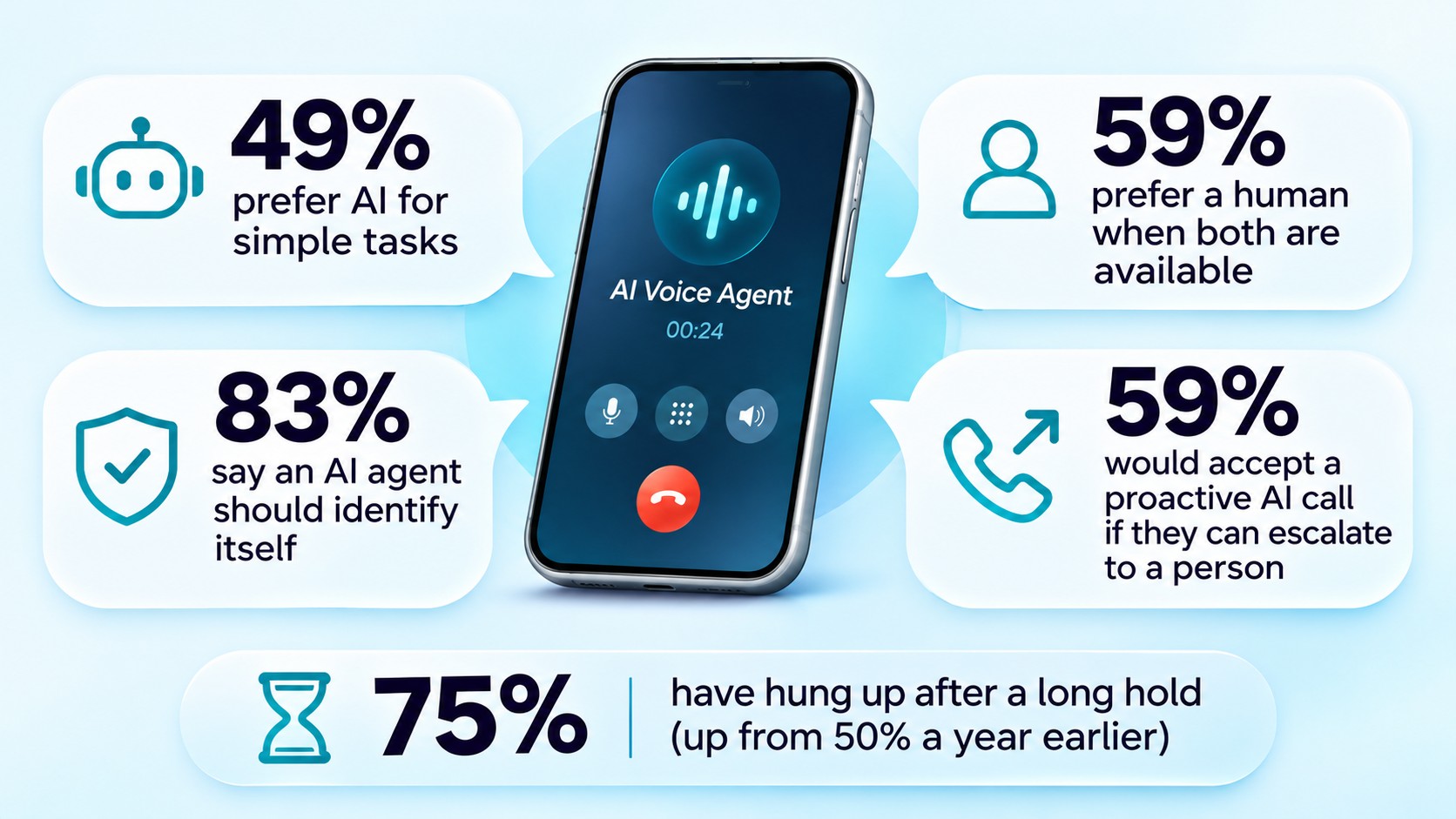
Quick answer: Most callers accept an AI agent for simple, fast tasks and still prefer a person when one is available or the stakes are high. In 2026 surveys, 49% preferred AI for simple tasks, while 59% preferred a human when both were offered. And 83% said an AI agent should identify itself. Disclosure and an easy route to a person do the most to win acceptance.
Key takeaways
- 59% of consumers prefer a human when both are available, and 61% in a separate survey of 5,000 people. (CX Foundation) (Verint)
- 49% prefer AI for simple tasks, and 59% would accept a proactive AI call if they can escalate. (Invoca) (No Jitter)
- Waiting is the bigger irritant. 75% said they had hung up after a long hold, up from 50% a year earlier. (Invoca)
- 83% say an AI agent should say what it is, and some states now require disclosure in certain situations. (CX Foundation) (Cooley)
What do the 2026 surveys say?
Five findings from three research firms give a consistent picture once they are read side by side.
Consumer attitudes to AI agents, 2026
| Number | What it measures | Source |
|---|---|---|
| 49% | Prefer AI for simple tasks | Invoca |
| 59% | Prefer a human when both are available | CX Foundation |
| 61% | Prefer a human agent, in a survey of 5,000 US consumers | Verint |
| 59% | Would accept a proactive call from an AI agent if they can escalate to a person | No Jitter |
| 83% | Say an AI agent should identify itself | CX Foundation |
The headline is acceptance with conditions. People will work with an AI agent when the task is simple and the AI is honest about what it is. They also want to know a person is available.
Why do the numbers seem to conflict?
They measure different things. “Which would you prefer?” is a question about an ideal. “Would you accept?” is a question about a real situation with tradeoffs.
Given a free choice, about six in ten people pick a human. (CX Foundation) (Verint) The same share will take a call from an AI when escalation is possible. (No Jitter) Both can be true of one person. Most of us would choose a human teller and still use the cash machine when the branch is closed.
Stakes shift the answer further. In Invoca’s research, 96% of buyers said human connection matters in a high-stakes purchase. (Invoca) Booking a haircut and choosing memory care for a parent are different calls, and people treat them differently.
What do callers dislike more than AI?
Callers dislike waiting more. The same Invoca survey found that 75% of consumers had hung up after a long hold, compared with 50% a year earlier. (Invoca) Among the reasons people gave for preferring AI, 43% cited fast answers and 35% cited avoiding hold time. (Invoca)
This changes what AI is being compared against. In practice, the alternative is rarely an attentive person who answers on the second ring. Across senior care providers, for instance, a person answers only 53% of inbound calls. (Invoca) For the other 47%, the practical choice is between an AI agent and a voicemail greeting or a menu.
VerbaCall answers right away, and you control the greeting, so the agent can say it is an AI assistant in its first sentence. Hear a live call
What 2026 surveys say about talking to an AI agent on the phone.
Should the agent say it is AI?
Yes, every time, for two reasons.
Callers expect it. That 83% figure is among the strongest results in any of these surveys. (CX Foundation)
The law is also moving in that direction. Utah’s AI law took effect in May 2024 and requires disclosure when a person asks. Maine’s took effect in September 2025 and applies when a reasonable consumer could believe they are dealing with a human. (Cooley) Other states have their own rules, and more are being proposed.
Disclosure costs one sentence. Our article on whether AI voice calls are legal covers consent and recording as well.
What does an acceptable AI call sound like?
An acceptable AI call is short and honest, with an easy way out. Here is an opening for a made-up dental office.
Opening lines, Sample script
AI agent: Thanks for calling Brightside Dental. I’m Anna, an AI assistant. I can book or change an appointment, or get you to someone on our team. What do you need today?
Caller: I need to move my cleaning on Thursday.
AI agent: I can do that. I have Friday at 9 or Monday at 2:30. Which works?
Caller: Actually, can I just talk to someone? I have a question about my bill.
AI agent: Of course. I’ll connect you with the front desk now and let them know it’s about billing.
Notice what the first line does. It says what the agent is and offers a person before the caller has to ask. When the caller does ask, the agent says yes and passes the reason along.
How do you design for acceptance?
Five practices follow from the survey results.
- Disclose in the first sentence Say “AI assistant” plainly.
- Get to the point State what the agent can do, then ask what the caller needs.
- Offer a person early Mention it in the greeting, and honor the request at once.
- Transfer with context Brief the staff member, so the caller does not repeat the story.
- Keep the AI on simple tasks Booking and basic questions. Hand off anything emotional or complicated.
The fourth step is where many setups fall down. A caller who escapes the AI only to start again with a person has had the worst of both. See how AI warm transfer works.
Test the escape hatch Book a demo and call the agent. Ask for a person at an awkward moment and hear what your callers would. Book a demo
How do you find out what your own callers think?
Measure it. National surveys describe averages, and your callers are a specific group.
| Signal | How to read it |
|---|---|
| Hang-ups in the first ten seconds | Reaction to the greeting or the disclosure |
| Requests for a person | How often callers want out, and at what point |
| Completed tasks | Calls where the agent finished the job |
| Opt-outs and complaints | Callers who objected strongly |
Listen to the recordings behind the first and fourth rows. A handful of calls will tell you whether the issue is the wording or the fact that an AI answered at all.
If the numbers are poor, change the opening before you change the product. Our vendor questions include how to test the handoff, and the comparison with answering services covers when a person should answer first.
Honest about being AI, quick to find a person Try VerbaCall free with 30 minutes of call time, or book a demo and hear the greeting for yourself. Book a demo or Try for free
This article is general information, not legal advice. Rules change and vary by state. Confirm your obligations with qualified counsel before you launch a campaign.
Frequently asked questions
Do people hang up when they hear an AI?
Some do, and the surveys suggest most will stay for a simple task if a person is reachable. In Metrigy’s research, 59% of consumers said they would accept a proactive AI call when an escalation path exists. (No Jitter) Measure your own early hang-up rate to see where your callers fall.
Does an AI agent have to say it is AI?
Some state laws require disclosure in certain situations. Utah’s law requires it when a person asks, and Maine’s applies where a reasonable consumer might think they are dealing with a human. (Cooley) Laws are changing, so check with counsel. As a matter of practice, disclose every time.
Do older callers accept AI agents?
The surveys here do not break AI acceptance out by age. They do show that older adults lean toward the phone: 52% of Baby Boomers prefer calling when they need help. (Invoca) A caller who chose the phone expects a conversation, so the route to a person matters even more.
What frustrates callers most about AI?
Being stuck. An agent that cannot answer and will not hand off produces the complaints people associate with automation. A quick transfer removes most of that risk.
Should an AI agent have a human name?
A name is fine and makes the call easier to follow. It should come with a plain statement that the caller is speaking with an AI assistant.
Sources
- Invoca, 2026. AI in Customer Experience: What 700 Buyers Told Us in 2026
- CX Foundation, June 2026. Coverage of Invoca’s 2026 B2C Buyer Experience Report
- Invoca, 2026. 2026 Report: Consumers Embrace AI, Demand for Fast Responses from Brands Increases
- No Jitter, reporting Metrigy research, August 2026. Consumers warming to AI customer service agents
- Verint, 2026. The State of Customer Experience 2026: The Human Preference Paradox
- Cooley, October 2025. AI Chatbots at the Crossroads: Navigating New Laws and Compliance Risks
- Invoca, July 2026. The Senior Care Lead Conversion Benchmarks Report
About VerbaCall. VerbaCall is an AI voice agent platform. It calls new leads within about 20 seconds, answers inbound calls at any hour, books appointments, and warm-transfers ready callers to your team. Each conversation is written back to your CRM, with text and email follow-up alongside. It is built on Twilio and serves US businesses in real estate, senior living, home care, healthcare, and restaurants. See how VerbaCall works.