Are AI Voice Calls Legal? The 2026 Rules on Consent and Disclosure
AI voice calls are legal in the US with the right consent. A plain-English guide to inbound and outbound rules, disclosure, recording, and opt-outs.
On this page
- Key takeaways
- What is the short answer by call type?
- What did the FCC decide?
- What counts as consent?
- What does the call itself have to include?
- Can you record the call?
- How do opt-outs work?
- What other rules apply?
- What are the penalties?
- What should you confirm before the first outbound AI call?
- Frequently asked questions
- Sources
Quick answer: Yes, AI voice calls are legal in the United States when the caller has the right consent. The FCC treats AI-generated voices as artificial voices under the TCPA, so outbound AI calls need prior express consent, and that consent must be in writing for marketing calls. Inbound calls answered by AI do not raise the same consent question, though recording and disclosure rules still apply.
Key takeaways
- The FCC confirmed in February 2024 that the TCPA covers AI-generated voices. (Federal Communications Commission)
- Outbound marketing calls with an AI voice need prior express written consent. Answering your own phone with AI does not.
- Artificial-voice calls must identify the business at the start, and marketing calls must offer a way to opt out. (Electronic Code of Federal Regulations)
- Federal law permits recording with one party’s consent, and about 11 states require everyone’s. (Reporters Committee for Freedom of the Press)
- A few states now require AI disclosure in certain situations. (Cooley)
What is the short answer by call type?
Legality depends on who started the call and what it is for. This table is a general summary of federal rules, and state law can add to it.
| Call type | Allowed? | What you need |
|---|---|---|
| A customer calls you and an AI agent answers | Yes | Honest identification, and a recording notice where required |
| An AI agent calls someone back who asked to be contacted | Yes | Prior express consent, in writing if the call is marketing (Federal Communications Commission) |
| An AI appointment reminder or service update | Yes | Prior express consent (Federal Communications Commission) |
| An AI marketing call to a purchased list | No | It lacks the written consent the rules require (Federal Communications Commission) |
| An AI call after the person opted out | No | Opt-outs must be honored (McGuireWoods) |
Most legitimate business uses sit in the first three rows. The trouble starts when a company treats a list of phone numbers as permission.
What did the FCC decide?
That an AI-generated voice is an “artificial” voice. The Telephone Consumer Protection Act has restricted calls with artificial or prerecorded voices since 1991. On February 8, 2024, the FCC released a ruling confirming that the restriction covers current AI technologies that generate human voices. (Federal Communications Commission)
The decision did not ban AI calls. It placed them under rules that already existed, which means the same consent that was needed for a prerecorded message is needed for an AI conversation.
What counts as consent?
Federal rules use two levels, and the difference matters. (Electronic Code of Federal Regulations)
Prior express consent
- Needed for informational calls with an artificial voice
- Can be given by providing a number for a stated purpose
- Covers messages such as reminders and confirmations
- Can be withdrawn at any time
Prior express written consent
- Needed for marketing calls with an artificial voice
- Requires a signed agreement, which can be electronic
- Must clearly authorize calls using automated or artificial voice technology
- Cannot be made a condition of buying something
If a call both confirms an appointment and promotes a service, treat it as marketing. When in doubt, collect the written form of consent. It covers both situations.
VerbaCall’s outbound calling has consent and opt-out handling built in, so the agent only calls leads you are cleared to call. See how it works
What does the call itself have to include?
Federal rules set the minimum. An artificial-voice call must state the identity of the business at the beginning, and it must give a phone number where the business can be reached. Marketing calls must also offer an automated way to opt out during the call. (Electronic Code of Federal Regulations)
Saying that the caller is an AI is good practice on top of that. In a 2026 survey, 83% of consumers said an AI agent should identify itself. (CX Foundation) State laws are heading the same way. Utah’s law, in force since May 2024, requires disclosure when a person asks. Maine’s, in force since September 2025, applies where a reasonable consumer could believe they are talking to a human. (Cooley)
A greeting such as “This is Anna, an AI assistant with Example Realty” names the business and discloses the AI in one sentence.
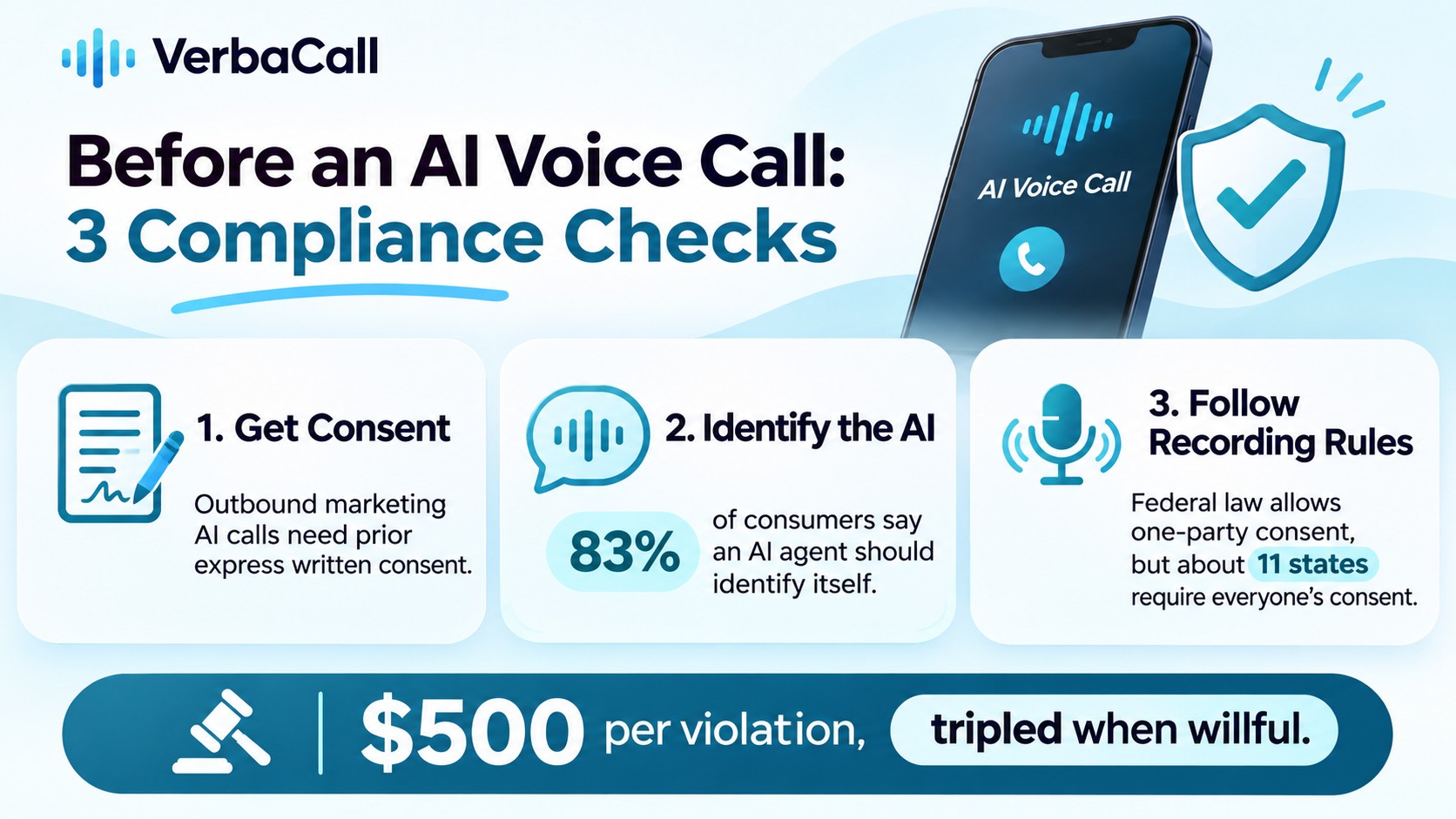
Three checks to clear before any outbound AI voice call.
Can you record the call?
Yes, you can record with notice. Federal law permits recording when one party to the call consents. About 11 states require the consent of everyone on the call. (Reporters Committee for Freedom of the Press)
You will rarely know for certain which state a caller is in. A short announcement at the start, such as “this call is recorded,” handles both kinds of state. Many AI voice products record and transcribe calls, so make the announcement part of the greeting.
How do opt-outs work?
A person can withdraw consent, and you must act on it. The FCC adopted updated rules on September 30, 2026, that let businesses designate specific opt-out methods as long as they are clearly disclosed. (McGuireWoods) Reply keywords and key presses are typical examples.
The current deadline for honoring an opt-out is 10 business days, and the FCC has proposed cutting it to seven. (McGuireWoods) Treat those as outer limits. Software can suppress a number in seconds, and it should.
Watch consent and opt-out work Book a demo to see how a lead’s consent status controls who gets called, and what happens when someone says stop. Book a demo
What other rules apply?
Four more areas apply, depending on your business.
| Area | What to know |
|---|---|
| Texts | Business texting needs carrier registration, known as 10DLC, and its own opt-in (Twilio) |
| Health information | HIPAA covered entities need a written agreement with any vendor that handles protected health information (U.S. Department of Health and Human Services) |
| Calling hours | Solicitation calls are limited to 8 a.m. to 9 p.m. in the called person’s time zone (Electronic Code of Federal Regulations) |
| State telemarketing laws | Several states add their own rules on hours or consent |
Our guides cover the first two in depth: 10DLC registration and HIPAA for AI voice agents.
What are the penalties?
The TCPA lets consumers sue for $500 per violation, and courts can triple that when the violation was willful or knowing. (Legal Information Institute) Because each call can be a separate violation, exposure grows with volume. Regulators and state attorneys general can bring their own actions as well.
What should you confirm before the first outbound AI call?
Before you launch
- Your forms collect written consent that mentions automated or AI voice calls
- You can show what each person agreed to, and when
- The agent names your business and says it is an AI assistant
- Callers hear that the call is recorded
- An opt-out stops calls and texts right away
- Calls go out only during permitted hours
Real estate teams will find industry detail in our TCPA guide for real estate. For how callers react to AI in the first place, see do callers mind talking to AI.
Legal calls start with consent Try VerbaCall free with 30 minutes of call time, or book a demo to see how consent controls every outbound call. Book a demo or Try for free
This article is general information, not legal advice. Rules change and vary by state. Confirm your obligations with qualified counsel before you launch a campaign.
Frequently asked questions
Is it legal to use AI for cold calling?
Not to consumers who have not given prior express written consent. An AI voice is an artificial voice under the TCPA, and marketing calls with artificial voices require that consent. (Federal Communications Commission) Calling people who asked to be contacted, and who agreed to automated or AI calls, is a different matter.
Do I need consent for an AI agent to answer my phone?
No consent is needed for the caller to reach you, because they placed the call. You should still say that the caller is speaking with an AI assistant and give notice if the call is recorded.
Does an AI caller have to say it is not human?
Federal rules require artificial-voice calls to state the identity of the business at the start. (Electronic Code of Federal Regulations) Some states go further. Utah requires disclosure when a person asks, and Maine requires it where a reasonable consumer could think they are dealing with a human. (Cooley) Disclosing every time keeps you clear of both.
Is AI calling legal in every state?
The federal rules apply nationwide, and states add their own. Some set narrower calling hours or have their own telemarketing laws, and recording rules differ. If you call across state lines, apply the strictest rule that could cover the call.
If something goes wrong, is the vendor or my business responsible?
Generally the business on whose behalf the calls are made. A vendor’s tools can enforce consent checks and opt-outs, but collecting valid consent is your job. Ask your attorney how liability is allocated in your vendor contract.
Sources
- Federal Communications Commission, February 2024. FCC Confirms TCPA Applies to AI Technologies That Generate Human Voices
- Electronic Code of Federal Regulations. 47 CFR 64.1200, Delivery restrictions
- Reporters Committee for Freedom of the Press. Introduction to the Reporter’s Recording Guide
- Cooley, October 2025. AI Chatbots at the Crossroads: Navigating New Laws and Compliance Risks
- McGuireWoods, October 2026. The FCC’s New TCPA Rules Give Businesses Opt-Out Control
- Legal Information Institute, Cornell Law School. 47 U.S. Code 227, Restrictions on use of telephone equipment
- U.S. Department of Health and Human Services. Are You a Covered Entity?
- Twilio, accessed November 2026. A2P 10DLC registration overview
- CX Foundation, June 2026. Coverage of Invoca’s 2026 B2C Buyer Experience Report
About VerbaCall. VerbaCall is an AI voice agent platform. It calls new leads within about 20 seconds, answers inbound calls at any hour, books appointments, and warm-transfers ready callers to your team. Each conversation is written back to your CRM, with text and email follow-up alongside. It is built on Twilio and serves US businesses in real estate, senior living, home care, healthcare, and restaurants. See how VerbaCall works.