TCPA Rules for Real Estate Teams Using AI Calls and Texts (2026)
What the TCPA requires before a real estate team uses AI voice calls or texts, covering consent, Do Not Call rules, opt-outs, and the 2026 FCC changes.
On this page
- Key takeaways
- What is the TCPA?
- Which rule applies to which kind of contact?
- What did the FCC say about AI voices?
- What should consent wording look like?
- Does the Do Not Call registry apply?
- What happened to the one-to-one consent rule?
- What changed for opt-outs in 2026?
- Which state laws matter?
- What does a violation cost?
- What should a team check before using AI calls or texts?
- Where does the software’s job end?
- Frequently asked questions
- Sources
Quick answer: Under the TCPA, a real estate team needs a person’s prior express written consent before placing marketing calls that use an AI or prerecorded voice. It must also follow Do Not Call rules and honor opt-out requests for calls and texts. The FCC confirmed in 2024 that AI-generated voices count as artificial voices. State laws such as Texas SB 140 add further requirements.
Key takeaways
- AI-generated voices are “artificial” under the TCPA, so marketing calls that use them need prior express written consent. (Federal Communications Commission)
- An agent dialing by hand, with no artificial voice, has more latitude, though Do Not Call rules still apply. (National Association of REALTORS)
- Do Not Call restrictions cover texts and AI voice messages as well as ordinary calls. (REALTOR Magazine)
- The FCC’s one-to-one consent rule was vacated in January 2025 and will not take effect. (Readymode)
- Statutory damages are $500 per violation and can be tripled for willful violations. (Legal Information Institute)
What is the TCPA?
Telephone Consumer Protection Act A 1991 federal law that restricts telemarketing and unsolicited faxes, along with calls made using autodialers or artificial and prerecorded voices. The FCC writes the detailed rules. Consumers can sue over violations.
Real estate runs on phone calls to people who have not yet become clients, so the law touches nearly every team. The rules are stricter for automated and artificial-voice calls than for an agent picking up the phone.
Which rule applies to which kind of contact?
This table is a summary for orientation. Your attorney should confirm how it applies to your business.
| Type of contact | What federal rules require |
|---|---|
| An agent dials by hand and speaks live | No prior written consent, but Do Not Call rules and calling hours apply (National Association of REALTORS) |
| A marketing call with an AI or prerecorded voice | Prior express written consent (Federal Communications Commission) |
| An informational AI call, such as an appointment reminder | Prior express consent (Federal Communications Commission) |
| A marketing text | Do Not Call rules apply, and carriers require opt-in (REALTOR Magazine) |
| Any call or text after an opt-out | Stop (McGuireWoods) |
The second row is the one that matters for AI voice products. A lead who typed a phone number into a form has not automatically agreed to be called by an artificial voice. The form’s wording decides that.
What did the FCC say about AI voices?
In a ruling released on February 8, 2024, the FCC confirmed that AI technologies that generate human voices fall under the TCPA’s restrictions on artificial or prerecorded voices. (Federal Communications Commission) The ruling targeted robocall scams that use cloned voices. It applies equally to an ordinary business using a synthetic voice to follow up on leads.
NAR’s guidance draws the practical line. Agents may place telemarketing calls without prior express written consent only if three things are true: they are not using an autodialer, they are not using artificial voice messages, and they are following Do Not Call rules. (National Association of REALTORS) An AI voice agent fails the second condition, so consent has to come first.
VerbaCall’s outbound calling has consent and opt-out handling built in, along with Do Not Call checks. See it for real estate
What should consent wording look like?
Consent wording should be clear and specific, and tied to your business by name. The example below shows the usual elements. Treat it as a starting point for your attorney, since wording needs to fit your state and your lead sources.
Sample consent wording for a lead form By submitting this form, I agree that Example Realty may call and text me at the number I provided about real estate services, including by automated means and with artificial or prerecorded voices, which may be AI-generated. Consent is not a condition of any purchase. Message and data rates may apply. Reply STOP to opt out of texts.
Keep a record of the wording each lead saw, with the date and the page it appeared on. If a dispute arises, that record is your evidence.
Does the Do Not Call registry apply?
Yes, the registry applies to calls and to texts. NAR notes that Do Not Call restrictions extend to text messages and to artificial voice messages created with generative AI. (REALTOR Magazine)
Two details matter for real estate teams. First, federal rules recognize an established business relationship for three months after a consumer’s inquiry to your business, which can permit calls to a number on the registry. (Electronic Code of Federal Regulations) That exception concerns the registry. It does not replace the consent needed for an artificial voice.
Second, you must keep your own internal do-not-call list and honor it. A person who tells one of your agents to stop calling should not hear from another agent on the same team.
Solicitation calls are also limited to the hours between 8 a.m. and 9 p.m. in the called person’s time zone. (Electronic Code of Federal Regulations) Some states set narrower windows.
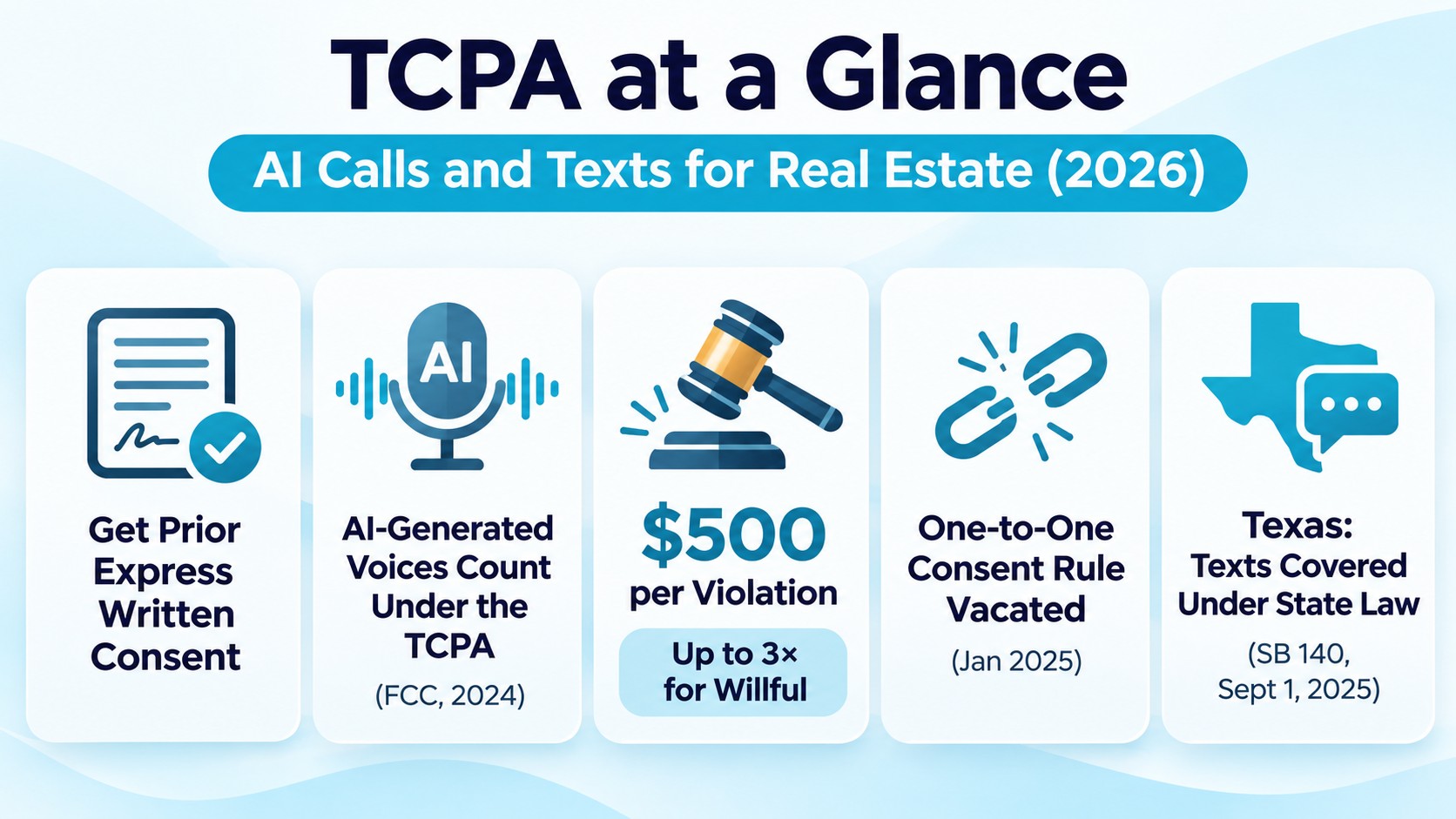
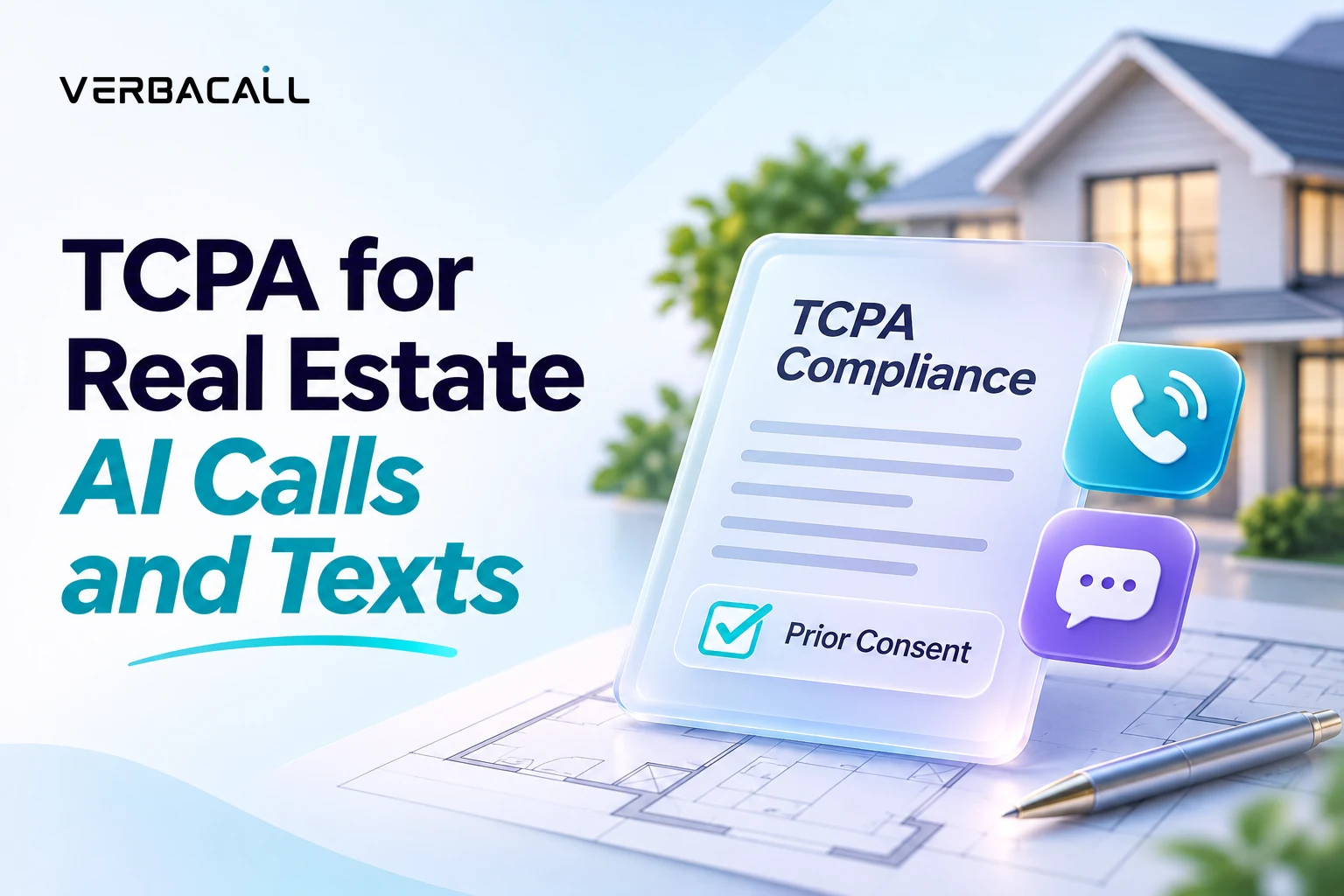
The five TCPA points real estate teams using AI calls and texts need to know.
What happened to the one-to-one consent rule?
It was struck down before it began. The FCC had adopted a rule that would have required consent to name one seller at a time. The Eleventh Circuit vacated it on January 24, 2025. (Readymode) NAR’s one-sheet confirms the rule will not take effect. (National Association of REALTORS)
The older requirements remain. Consent still has to be clear, and it still has to cover the business that is calling. Leads bought or shared from third parties deserve a close look at what the consumer was shown.
What changed for opt-outs in 2026?
The FCC adopted new rules on September 30, 2026. (McGuireWoods) Law firm summaries highlight two changes.
- Businesses may designate specific methods for opting out, such as replying with a keyword or pressing a key, provided they disclose those methods clearly.
- For informational messages, an opt-out can be treated as applying to that category of message. An opt-out from telemarketing still ends all future telemarketing.
The order takes effect 30 days after publication in the Federal Register, so confirm its status before changing any process. (McGuireWoods) Whatever the fine print, the safe practice has not changed. When someone says stop, stop on every channel.
See an opt-out handled on a live call Book a demo and tell the agent to stop calling. You will see the number suppressed from future calls and texts. Book a demo
Which state laws matter?
More state laws matter each year. Texas is the clearest recent example. Senate Bill 140 took effect on September 1, 2025, and brought text messages within the state’s telephone solicitation law. It also gave consumers a route to sue. (National Law Review)
Recording laws vary too. Federal law allows recording with one party’s consent, while about 11 states require all parties to agree. (Reporters Committee for Freedom of the Press) An announcement at the start of each call covers both situations.
If your team calls into several states, follow the strictest rule that applies to any of them.
What does a violation cost?
The statute sets damages at $500 per violation, and a court may triple that for a willful or knowing violation. (Legal Information Institute) Each call or text can count separately. A campaign of a few hundred messages sent without proper consent adds up quickly, which is why these cases are often brought as class actions.
What should a team check before using AI calls or texts?
Compliance checklist
- Every lead form carries consent wording that names your business and covers AI or artificial voices
- The wording each lead saw is stored with a date
- Numbers are checked against the national registry and your internal do-not-call list
- Calls are limited to permitted hours in the lead’s time zone
- The agent states your business name at the start of each call
- Opt-outs are honored immediately on every channel
- Texting numbers are registered for 10DLC
- Callers are told when a call is recorded
The seventh item has its own process, covered in our 10DLC registration guide.
Where does the software’s job end?
A good product enforces the rules you give it. VerbaCall’s outbound calling includes consent and opt-out handling, and it keeps a Do Not Call list current. It will not call a lead outside the hours you set.
Software cannot fix consent that was never collected. The forms and their wording are yours, and so is the choice of lead sources. Get those right first, then let the agent do the calling. For the broader legal picture, read are AI voice calls legal. For how to space contacts once consent is in place, see our follow-up cadence guide.
Call fast, with consent first Try VerbaCall free with 30 minutes of call time, or book a demo to see consent and opt-out handling. Book a demo or Try for free
This article is general information, not legal advice. Rules change and vary by state. Confirm your obligations with qualified counsel before you launch a campaign.
Frequently asked questions
Can I use an AI voice agent to cold call expired listings or FSBOs?
Not without prior express written consent from the person you are calling. An AI voice is an artificial voice under the TCPA. (Federal Communications Commission) A licensed agent dialing by hand may be able to make those calls, subject to Do Not Call rules, which is the distinction NAR draws in its guidance. (National Association of REALTORS)
Do leads from portals come with consent for AI calls?
It depends on the wording the consumer agreed to on that portal. Ask each lead source for its exact consent language, and check whether it covers your brokerage and calls made with an artificial or AI voice. If it does not, have a person make the first call.
Does the TCPA apply to text messages?
Do Not Call rules apply to texts, according to NAR’s summary of FCC rules. (REALTOR Magazine) Carriers also require registration and opt-in for business texting, which our 10DLC guide explains. Several states have their own laws, and Texas now treats texts as telephone solicitations. (National Law Review)
How quickly must I honor an opt-out?
The current federal limit is 10 business days, and the FCC has proposed shortening it to seven. (McGuireWoods) In practice, suppress the number immediately. A product that waits days to stop contacting someone invites complaints.
Who gets sued, the agent or the brokerage?
Both have been named. REALTOR Magazine has reported on a rise in telemarketing lawsuits against agents and their brokerages. (REALTOR Magazine) Brokerages should set a written policy and make sure every team’s tools follow it.
Sources
- Federal Communications Commission, February 2024. FCC Confirms TCPA Applies to AI Technologies That Generate Human Voices
- National Association of REALTORS, March 2025. TCPA Best Practices One-Sheet
- REALTOR Magazine. More Telemarketing Lawsuits Ensnare Agents, Brokerages
- Readymode, January 2025. The FCC’s One-to-One Consent Rule Ends Before It Begins
- McGuireWoods, October 2026. The FCC’s New TCPA Rules Give Businesses Opt-Out Control
- Electronic Code of Federal Regulations. 47 CFR 64.1200, Delivery restrictions
- Legal Information Institute, Cornell Law School. 47 U.S. Code 227, Restrictions on use of telephone equipment
- National Law Review, September 2025. Texas Expands Its Mini-TCPA: Text Messages Now Covered, Litigation Risk Rises
- Reporters Committee for Freedom of the Press. Introduction to the Reporter’s Recording Guide
About VerbaCall. VerbaCall is an AI voice agent platform. It calls new leads within about 20 seconds, answers inbound calls at any hour, books appointments, and warm-transfers ready callers to your team. Each conversation is written back to your CRM, with text and email follow-up alongside. It is built on Twilio and serves US businesses in real estate, senior living, home care, healthcare, and restaurants. See how VerbaCall works.