A 14-Day Real Estate Lead Follow-Up Cadence You Can Copy
An eight-touch, 14-day follow-up cadence for new real estate leads, with sample messages for each step and clear rules for when to stop.
On this page
- Key takeaways
- Why does a cadence beat following up when you have time?
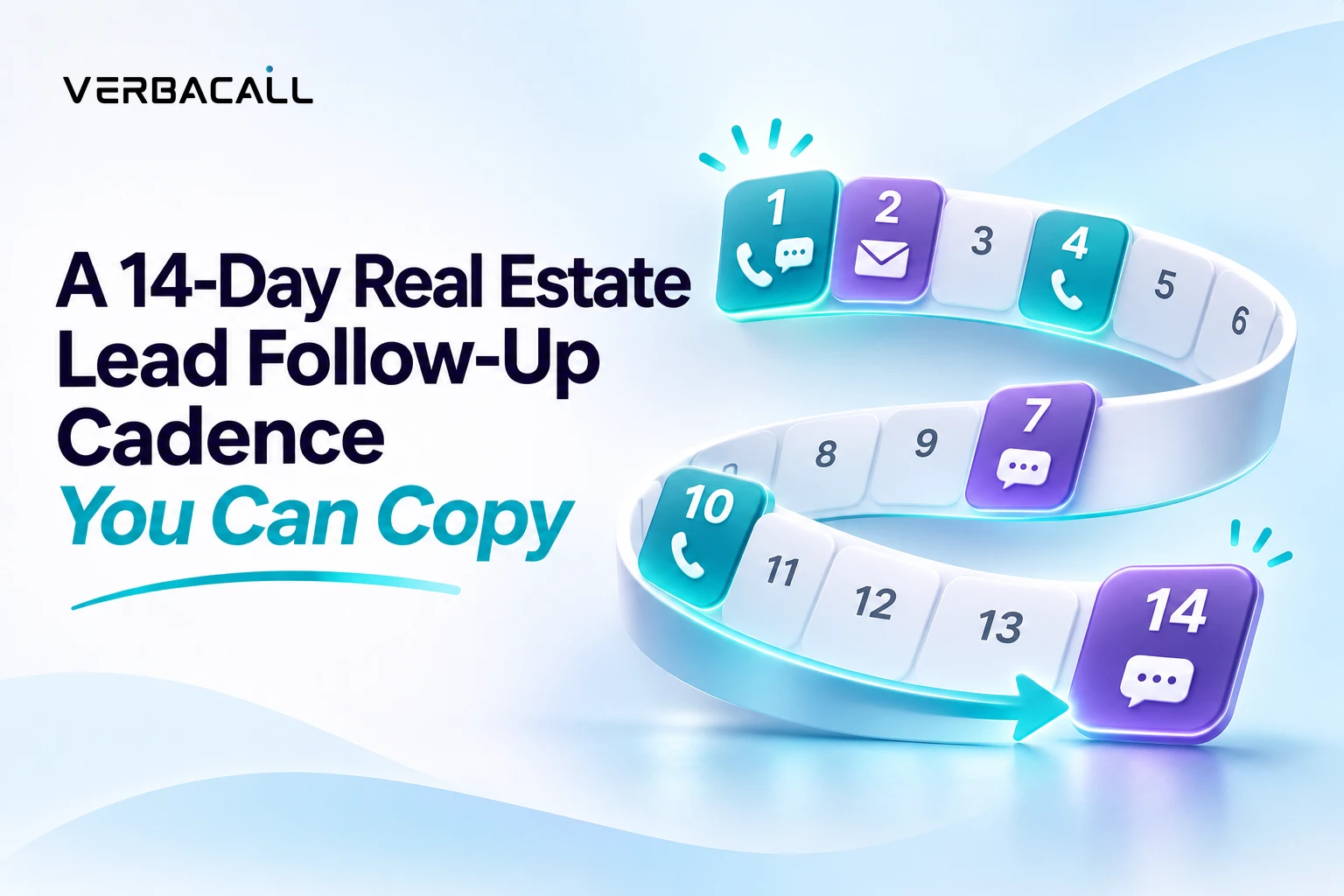
- What does the 14-day cadence look like?
- What should each message say?
- When should the cadence stop?
- What rules apply to the calls and texts?
- How do you run this without living in your CRM?
- What comes after day 14?
- Frequently asked questions
- Sources
Quick answer: A workable cadence for a new real estate lead is eight touches over 14 days. Make two calls and send a text on day one, then alternate calls with texts and email on days 2, 4, 7, 10, and 14. Stop as soon as the lead replies or opts out, and move silent leads to a monthly check-in.
Key takeaways
- Agents in one study made an average of 1.5 call-back attempts per inquiry, far fewer than a cadence needs. (WAV Group)
- Put the most effort into day one, when the lead still remembers the inquiry.
- Give each touch one purpose and one question.
- An opt-out on any channel should stop every channel.
- After 14 quiet days, switch to a monthly check-in instead of deleting the lead.
Why does a cadence beat following up when you have time?
Because “when I have time” usually means once. In the WAV Group study of 384 brokers and agents, the average inquiry got 1.5 call-back attempts and about two emails. (WAV Group) Then the lead was left alone.
A written cadence removes the decision. Nobody has to remember whether Tuesday’s open house visitor got a second call. The plan says day four is an email, so day four is an email.
Persistence is also where vendors place their bets. Ylopo, for example, says its AI voice product calls a lead 14 times over 90 days. (Ylopo) You do not need to match that, but it shows how far past one attempt the professionals go.
What does the 14-day cadence look like?
The cadence has eight touches and is heaviest at the start. The first day does most of the work because that is when the lead remembers asking.
| Day | Touch | Channel | Purpose |
|---|---|---|---|
| 1, within 5 minutes | 1 | Call | Reach them while the inquiry is fresh |
| 1, right after | 2 | Text | Give a screened caller a reason to pick up |
| 1, evening | 3 | Call | Catch them after work |
| 2 | 4 | Send something useful, such as matching listings | |
| 4 | 5 | Call | Ask one question about timing |
| 7 | 6 | Text | Offer a specific next step |
| 10 | 7 | Call and voicemail | Share one new fact about their search area |
| 14 | 8 | Text | Close the loop and set expectations |
Day one follows the same logic as our speed-to-lead targets. If the lead came from a portal, compress the schedule using the seven-day portal plan instead.
What should each message say?
Each message should say one thing. A touch that asks two questions gets no answer to either. These samples are starting points, written for a buyer who asked about a listing.
Touch 2, the first text Hi Maria, it’s Jordan with Carter Realty. I just tried you about 42 Oak Street. It’s still available. Want to see it this week? Reply STOP to opt out.
Touch 5, the day-four call “Hi Maria, Jordan again. Quick question and I’ll let you go. Are you hoping to move in the next couple of months, or later in the year?”
Touch 7, the day-ten voicemail “Maria, it’s Jordan. Two homes near Oak Street came on the market this week under your price range. I’ll text you the links.”
Touch 8, the closing text Hi Maria, I don’t want to crowd your inbox. I’ll send a short market note once a month, and you can reach me any time at this number.
VerbaCall’s cadence builder sequences calls with texts and email, using the delays you choose, and stops when the lead books or opts out. See it for realtors
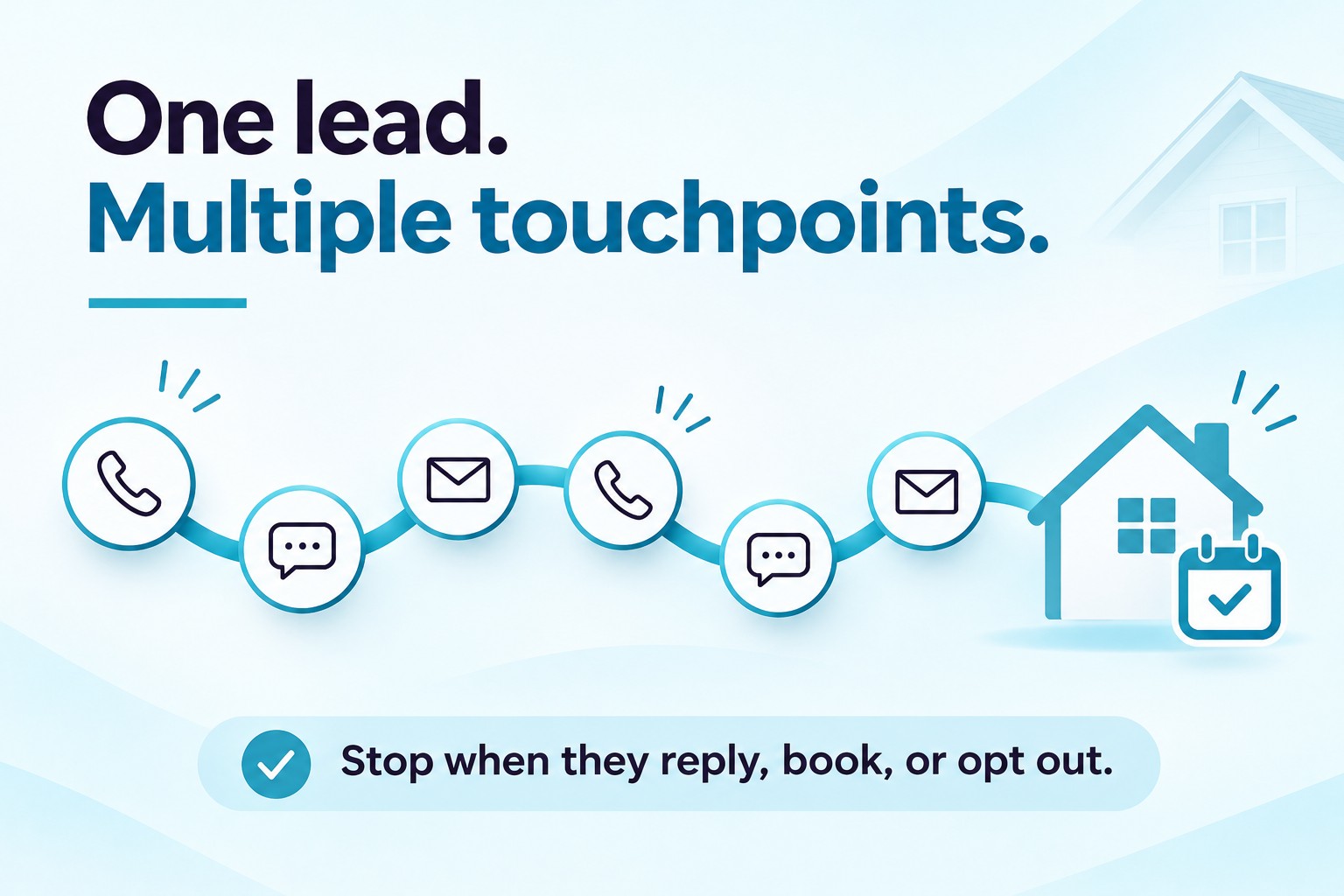
Eight touches over 14 days, ending the moment a lead replies, books or opts out.
When should the cadence stop?
The cadence should stop earlier than you think, in four situations.
- The lead replies. From that point a person or a live conversation takes over, and the schedule is off.
- The lead books a showing or a call.
- The lead says they have an agent. Thank them and close the record.
- The lead opts out on any channel, in any wording.
That last one deserves care. A reply of “stop” to a text should also end the calls and the emails. Leads do not think in channels, and neither do regulators.
What rules apply to the calls and texts?
A few federal rules shape any cadence, and some states add their own.
Outbound calls that use an AI-generated voice need the called person’s prior consent, because the FCC classes those voices as artificial under the TCPA. (Federal Communications Commission) Marketing texts need consent as well. Calls should fall between 8 a.m. and 9 p.m. in the recipient’s time zone.
Opt-out handling was updated by an FCC order adopted in September 2026. It lets a business name the methods it will accept, such as a reply keyword or a designated number, as long as that choice is clearly disclosed. For marketing messages, an opt-out still ends all future telemarketing from that sender. (McGuireWoods)
None of this is hard to follow once it is built into the process. Our TCPA guide for real estate agents lays out the checklist.
Let the first week run itself Start a free trial and build this cadence with a ready-made real estate agent. The trial includes 30 minutes of call time. Start a free trial
How do you run this without living in your CRM?
Automate the schedule and keep the conversations. Most CRMs can send the texts and emails on a timer. The calls are harder, since they need someone to dial at a set time and know what was said before.
Teams solve that in one of two ways. Some assign an inside sales agent to work a daily call list. Others connect an AI voice agent that places each call and asks the planned question, then writes the answer to the contact. Either way, review a sample of calls each week. A cadence nobody listens to drifts.
What comes after day 14?
After day 14, the rhythm slows. Send one short, useful message a month, such as a price change nearby or a new listing that fits. Call once a quarter.
Some of those quiet leads will resurface on their own. Others need a deliberate campaign, which is what database reactivation is for.
Eight touches, none of them forgotten Book a demo to see the cadence run on a test lead, or try VerbaCall free. Book a demo or Try for free
Frequently asked questions
How many times should I follow up with a real estate lead?
Eight touches in the first 14 days is a reasonable floor for a new inquiry. After that, one useful message a month keeps you in view without wearing out your welcome.
What is the best time of day to call a lead?
The best time is right after they inquire. For later attempts, vary the hour. Try a lunch break one day and an early evening the next, and stay between 8 a.m. and 9 p.m. in the lead’s time zone.
Should every touch be a phone call?
- Calls qualify fastest, but a lead who screens calls may answer a text. Mixing channels reaches people the way they prefer, and it keeps any one channel from feeling like pressure.
When should I give up on a lead?
Stop active follow-up after 14 days without a reply, and stop everything the moment someone asks you to. A quiet lead goes to monthly nurture. A lead who opted out comes off every list.
Can software run this cadence for me?
Yes. Most CRMs can schedule the texts and emails. An AI voice agent can also place the calls and stop the sequence when the lead books or opts out. Listen to the first week of calls before you trust any automation with your leads.
Sources
- WAV Group, January 2014. Agent Responsiveness Study
- Ylopo, accessed November 2026. AI for Real Estate
- Federal Communications Commission, February 2024. FCC Confirms TCPA Applies to AI Technologies That Generate Human Voices
- McGuireWoods, October 2026. The FCC’s New TCPA Rules Give Businesses Opt-Out Control
About VerbaCall. VerbaCall is an AI voice agent platform. It calls new leads within about 20 seconds, answers inbound calls at any hour, books appointments, and warm-transfers ready callers to your team. Each conversation is written back to your CRM, with text and email follow-up alongside. It is built on Twilio and serves US businesses in real estate, senior living, home care, healthcare, and restaurants. See VerbaCall for realtors.