10DLC Registration Explained for Businesses That Text Leads
What 10DLC registration is, who needs it, what it costs, and the mistakes that get campaigns rejected, based on Twilio's published requirements.
On this page
- Key takeaways
- What is 10DLC?
- Who needs to register?
- What are the two parts of registration?
- What does it cost?
- How do you register, step by step?
- Why do campaigns get rejected?
- What should your messages include?
- Is registration the same as consent?
- How does this fit with AI calling?
- Frequently asked questions
- Sources
Quick answer: 10DLC registration is the process US carriers require before a business can send texts from a standard ten-digit phone number using software. You register your business as a brand and your messaging purpose as a campaign through The Campaign Registry, usually via your texting provider. On Twilio, a standard brand costs $44 once, and unregistered messages to US numbers are blocked.
Key takeaways
- Registration has two parts: a brand for your business and a campaign for each messaging use. (Twilio)
- On Twilio, unregistered messages to US numbers have been fully blocked since August 31, 2023. (Twilio)
- Fees on Twilio are $44 once for a standard brand and $15 for campaign vetting, plus $1.50 to $10 a month per campaign. (Twilio)
- Missing or incomplete opt-in details are a common reason campaigns are rejected. (Twilio)
What is 10DLC?
10DLC Ten-digit long code. The system US mobile carriers use to identify businesses that send texts from standard local numbers through software. Registration links your messages to a verified business and a stated purpose.
Carriers introduced it to cut spam. A text from a registered sender arrives with a known business behind it. A text from an unregistered sender looks like the traffic carriers are trying to stop, and it is treated that way.
Who needs to register?
Any business that sends texts to US numbers from a ten-digit number using an application. That includes a CRM that texts leads and an AI agent that follows a call with a message.
It does not matter whether a person or an automation triggers each message. If the text goes out through a software platform, the registration requirement applies. (Twilio)
Voice calls are separate. A phone call does not need 10DLC registration, though caller ID reputation has its own rules, which we cover in fixing “Spam Likely” labels.
What are the two parts of registration?
A brand and a campaign, both filed with The Campaign Registry through your texting provider. (Twilio)
| Part | What it is | What you submit |
|---|---|---|
| Brand | Your business identity | Legal name, tax ID, address, website, and a contact |
| Campaign | One messaging purpose | A description of the use and how people opt in, with sample messages |
One brand can hold several campaigns. A brokerage might have one campaign for lead follow-up and another for appointment reminders.
VerbaCall is built on Twilio, and its outbound messaging is 10DLC compliant. See how it works
What does it cost?
The carrier-side fees are modest. These are the amounts Twilio lists. (Twilio)
10DLC fees on Twilio
| Number | What it measures | Source |
|---|---|---|
| $44 | One-time registration for a standard brand | Twilio |
| $4 | One-time registration for a low-volume or sole proprietor brand | Twilio |
| $15 | Vetting fee for each campaign | Twilio |
| $1.50 to $10 | Monthly fee per campaign, depending on the type | Twilio |
Your texting provider may add its own charges, and message fees are separate. Ask for the full list before you start.
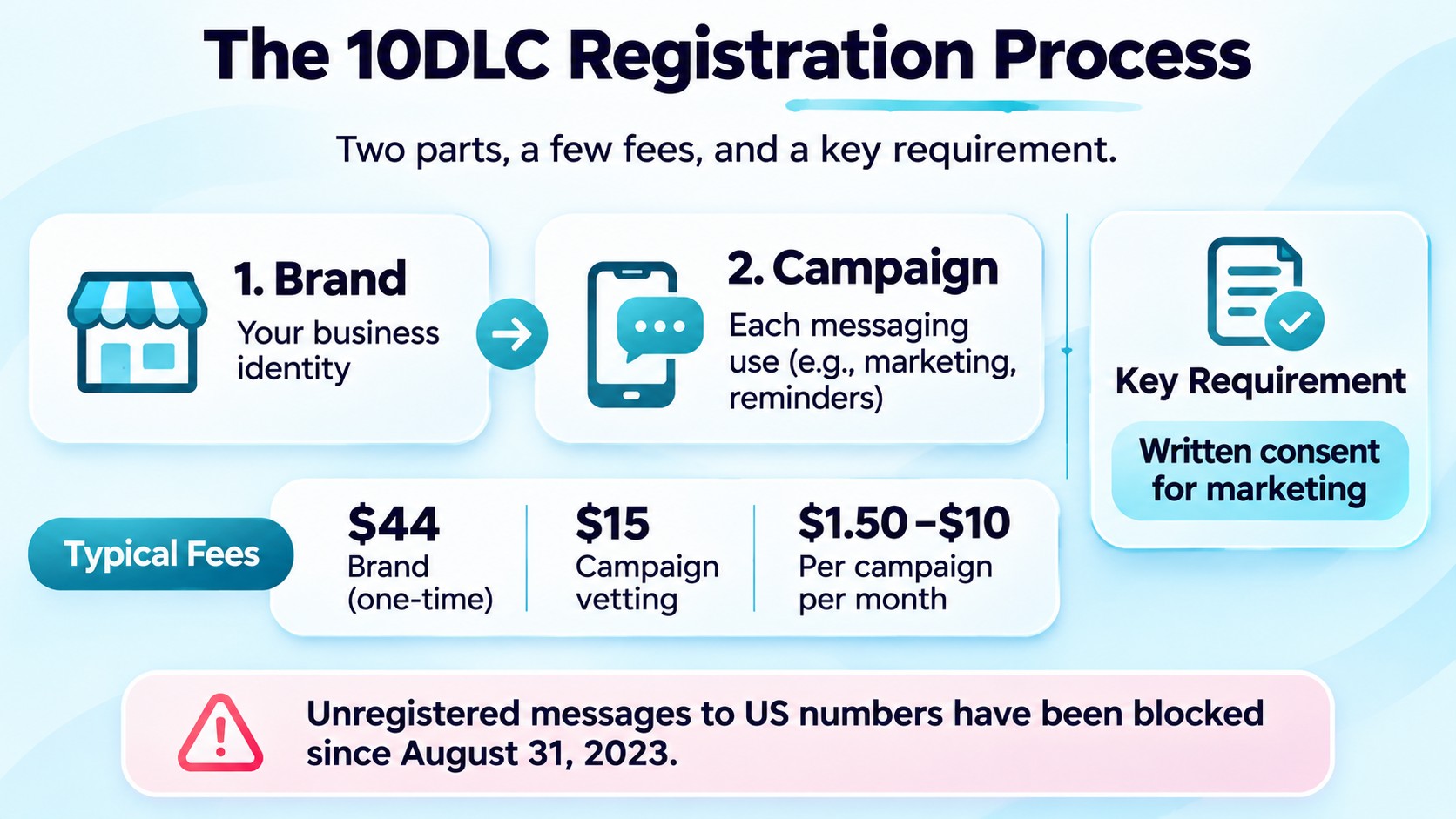
Two registrations, a few fees, and one requirement that trips up most applications.
How do you register, step by step?
Registration takes six steps. Most of the effort is in the second and fourth.
- Confirm who registers If you text through a vendor’s platform, ask whether the registration is filed under your own business name.
- Gather your business details Use the exact legal name and tax ID on your official records, plus your address and a working website.
- Register the brand Choose the brand type that matches your business. A company with an EIN registers as a standard brand. (Twilio)
- Register the campaign Describe who sends the messages and who receives them, and give the reason. Add sample messages and your opt-in process.
- Wait for vetting A third party reviews the campaign. Do not schedule a launch until it is approved.
- Connect your numbers and send Assign the approved campaign to the numbers you will text from.
Start early. Approval is outside your control, and a launch date built around an unapproved campaign will slip.
Why do campaigns get rejected?
Campaigns are usually rejected for missing detail. Twilio’s own guidance lists the problems reviewers find most often. (Twilio)
| Problem | What reviewers want to see |
|---|---|
| Vague campaign description | The sender and the recipients, plus the reason for the messages |
| Weak or missing opt-in | The exact form or script where people agree to receive texts, with a checkbox that is not pre-ticked |
| Privacy policy gaps | A statement that mobile numbers and opt-in data are not shared with or sold to third parties |
| Missing disclosures | Brand name, “Message and data rates may apply,” and opt-out instructions such as “Reply STOP” |
| Website problems | A live, public site whose name matches the business |
| Wrong brand type | A standard brand for any business with a tax ID |
The privacy policy row catches many businesses. Twilio describes the absence of that language as a major source of rejection. (Twilio) Add the sentence to your policy before you apply.
One more point from the same guidance: spoken consent is not enough for marketing campaigns. Marketing use cases need consent in writing. (Twilio)
What should your messages include?
Enough for the recipient to know who is texting and how to stop it.
In every program
- Your business name in the first message
- A clear reason for the message that matches your campaign
- Opt-out instructions, such as “Reply STOP to opt out”
- No content outside the use you registered
The FCC’s 2026 rules allow businesses to designate specific opt-out methods, including reply keywords, when they disclose them. (McGuireWoods)
Is registration the same as consent?
No, and confusing the two is risky. Registration is between you and the carriers. Consent is between you and each person you text.
A registered campaign that texts people who never agreed is still a legal problem. Do Not Call rules apply to texts. (REALTOR Magazine) Collect consent on your forms and keep a record of it. Honor every opt-out.
See calls and texts in one cadence Start a free trial and build a follow-up sequence. The trial includes 30 minutes of call time. Start a free trial
How does this fit with AI calling?
Texts usually follow calls. An AI agent rings a new lead, and if nobody answers, a text explains who called. That text needs a registered campaign behind it.
Plan the registration alongside the calling setup so the two are ready together. Our comparison of AI calling and AI texting covers which channel should go first, and the TCPA guide covers consent for both.
Texts that arrive Try VerbaCall free with 30 minutes of call time, or book a demo to see calling and texting set up together. Book a demo or Try for free
This article is general information, not legal advice. Rules change and vary by state. Confirm your obligations with qualified counsel before you launch a campaign.
Frequently asked questions
What does 10DLC stand for?
Ten-digit long code, meaning an ordinary local phone number. You will also see “A2P,” for application-to-person, which describes texts sent by software instead of typed by an individual on a personal phone.
Do I need to register if I only send a few texts?
Yes, if they are sent through software from a ten-digit number. Twilio offers low-volume and sole proprietor options with a $4 brand fee for small senders. (Twilio)
What happens if I do not register?
Your messages do not arrive. Twilio has fully blocked unregistered messages to US numbers since August 31, 2023. (Twilio)
Does registration give me permission to text people?
- Registration tells carriers who you are. You still need each person’s consent, and Do Not Call rules apply to texts. (REALTOR Magazine) See our TCPA guide.
Can I register as a sole proprietor?
Only if your business has no tax ID. Twilio states that a business with an EIN must register as a standard brand, and that EIN holders who apply as sole proprietors are rejected. (Twilio)
Sources
- Twilio, accessed November 2026. A2P 10DLC registration overview
- Twilio, March 2025. Improving Your Chances of A2P 10DLC Registration Approval
- REALTOR Magazine. More Telemarketing Lawsuits Ensnare Agents, Brokerages
- McGuireWoods, October 2026. The FCC’s New TCPA Rules Give Businesses Opt-Out Control
About VerbaCall. VerbaCall is an AI voice agent platform. It calls new leads within about 20 seconds, answers inbound calls at any hour, books appointments, and warm-transfers ready callers to your team. Each conversation is written back to your CRM, with text and email follow-up alongside. It is built on Twilio and serves US businesses in real estate, senior living, home care, healthcare, and restaurants. See how VerbaCall works.