AI Calling vs. AI Texting: Which Should Reach a Lead First?
When an AI call should come before a text and when the reverse is better, plus the consent and registration rules for each channel.
On this page
- Key takeaways
- What is each channel good at?
- Why does the call usually go first on a new lead?
- What rules apply to each?
- Which channel should go first, by situation?
- How do established vendors sequence them?
- What does a combined cadence look like?
- What mistakes should you avoid?
- Frequently asked questions
- Sources
Quick answer: AI calling reaches a lead in real time and can qualify and book in a single conversation. AI texting is less intrusive and can be answered later. Call first when someone has just asked to be contacted and has given consent. Text first when the hour is late or a call goes unanswered. Both need consent, and business texting also requires 10DLC registration.
Key takeaways
- 41% of consumers prefer calling when they need help, and the figure is 52% among Baby Boomers. (Invoca)
- 59% say they would accept a proactive call from an AI agent if they can reach a person. (No Jitter)
- AI voice calls need prior consent under the TCPA, and carriers block unregistered business texts to US numbers. (Federal Communications Commission) (Twilio)
- Established vendors pair the channels. Aline Connect uses calls and texts across up to 20 attempts in 90 days. (Aline via PR Newswire)
What is each channel good at?
A call is a conversation, and a text is a note left on the door. They solve different problems.
AI calling
- Gets an answer now, or not at all
- Qualifies and books in one conversation
- Carries tone, which matters in sensitive decisions
- Allows a live transfer to a person
AI texting
- Can be read and answered hours later
- Feels lighter, so it suits a first nudge after a missed call
- Works when the lead is at work or in a meeting
- Leaves a written record the lead can refer back to
The costs to the lead differ too. A call asks for attention immediately. A text asks for almost none, which is why it gets ignored more easily.
Why does the call usually go first on a new lead?
Because timing does most of the work, and a call uses it best. Companies that contacted a lead within an hour were nearly seven times as likely to qualify it as those that waited an hour longer, in a Harvard Business Review study. (Harvard Business Review)
A person who filled out a form 20 seconds ago has the phone in hand and the question in mind. A call at that moment can cover in one short conversation what a text exchange spreads over a day. We go through the evidence in speed to lead in real estate.
Preference data points the same way for people seeking help. In Invoca’s 2026 survey, 41% of consumers preferred calling when they needed help, and 52% of Baby Boomers did. (Invoca) Separate research from Metrigy found 59% of consumers willing to accept a proactive AI call, provided they could escalate to a person. (No Jitter)
VerbaCall calls a new lead within about 20 seconds, and sends the follow-up text if nobody answers. Hear a live call
What rules apply to each?
Both channels are regulated, in slightly different ways. This table is a summary, and your attorney should confirm how it applies to you.
| Topic | AI voice calls | Texts |
|---|---|---|
| Consent | Prior express consent, in writing for marketing calls (Federal Communications Commission) | Consent for marketing texts, and Do Not Call rules apply (REALTOR Magazine) |
| Registration | None for voice, though number reputation matters | 10DLC brand and campaign registration (Twilio) |
| Hours | Solicitation calls between 8 a.m. and 9 p.m. local time (Electronic Code of Federal Regulations) | State rules vary, and Texas treats texts as solicitations (National Law Review) |
| Opt-out | Must be honored | Must be honored, and reply keywords such as “stop” are a standard method (McGuireWoods) |
The registration row surprises people. Texting from a business number without 10DLC registration does not work. The messages are blocked. (Twilio)
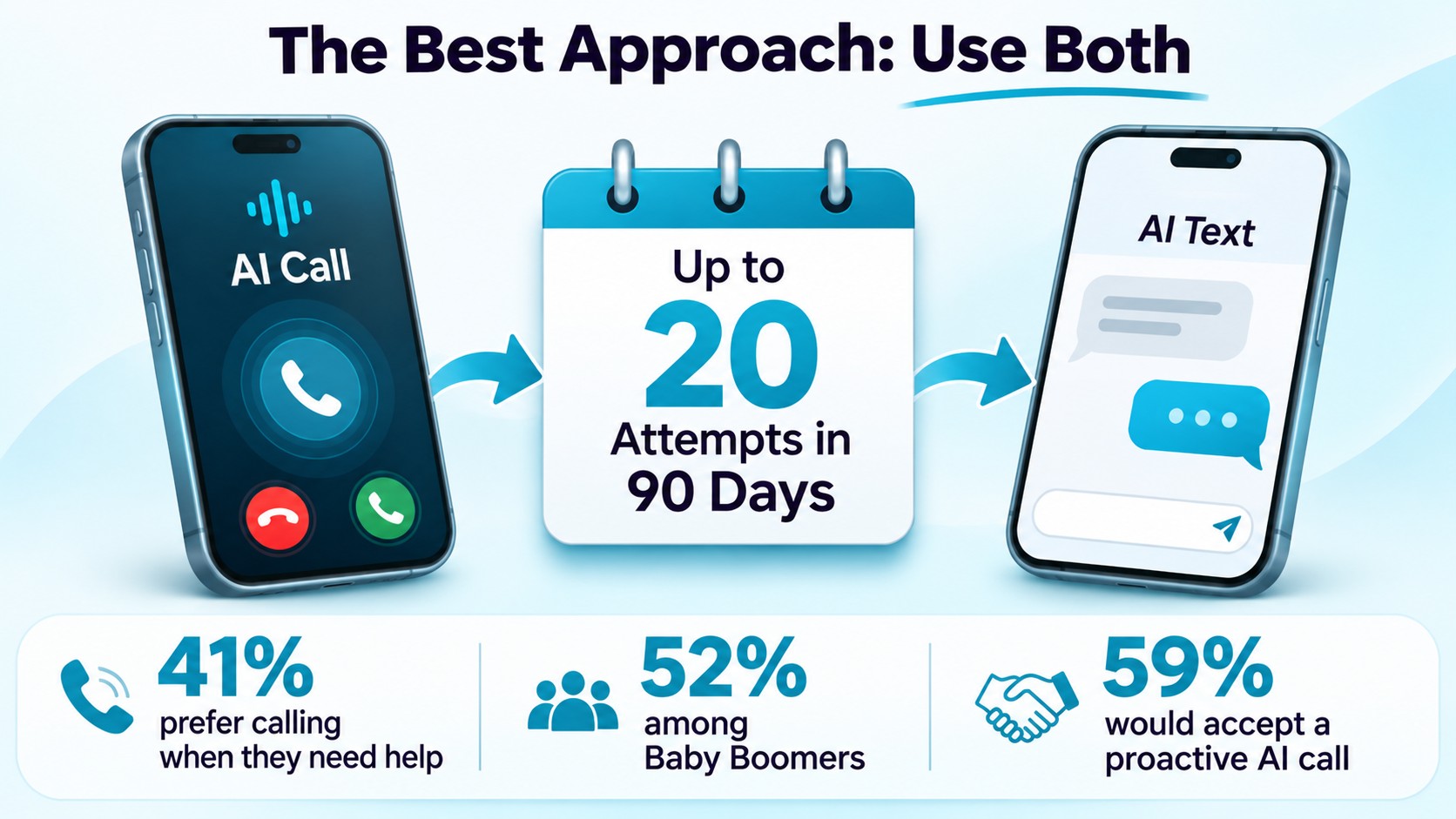
Calls and texts work best together in one follow-up sequence.
Which channel should go first, by situation?
| Situation | First touch | Then |
|---|---|---|
| New web or portal lead, daytime | Call within seconds | Text if no answer |
| New lead at 10 p.m. | Text or email right away | Call the next morning |
| Senior living web inquiry | Call | Text the tour confirmation |
| Old lead in the database | Email, or a text where you have consent | Call those who reply |
| Appointment reminder | Text | Call if unconfirmed |
| Lead who replied by text before | Text | Call once they engage |
The fourth row deserves caution. Older records often lack clear consent for automated contact. Check before you send anything, and see our guide to database reactivation.
How do established vendors sequence them?
They use both, and they publish how. Ylopo requires its AI Text product before a customer can add AI Voice, and its voice product then calls a lead 14 times over 90 days. (Ylopo) In senior living, Aline Connect combines calls and texts across up to 20 attempts in 90 days, between 8 a.m. and 8 p.m. (Aline via PR Newswire)
Neither treats the channels as rivals. The debate about which is better mostly disappears once a product can do both in order.
What does a combined cadence look like?
Five steps cover most new leads. Adjust the timing to your market.
- Call at once Within seconds of the inquiry, during calling hours.
- Text if there is no answer Say who you are and why you called, then offer a time to talk.
- Call again later the same day Choose a different hour from the first attempt.
- Send something useful on day two or three A listing or a guide that answers the question they asked.
- Space out the rest Alternate calls and messages over the following weeks, and stop when they book or opt out.
Our follow-up cadence guide has a day-by-day version for real estate.
Build the sequence once Start a free trial and set up a cadence that mixes calls with texts and emails. The trial includes 30 minutes of call time. Start a free trial
What mistakes should you avoid?
Four mistakes come up often.
- Texting from an unregistered number, then wondering why nobody replies.
- Sending AI calls to leads whose consent covered only email.
- Letting a call and a text arrive in the same minute, which reads as pressure.
- Continuing on one channel after the lead opted out on the other.
The last one is a legal issue as much as a courtesy. Our guides to TCPA rules for real estate and whether AI voice calls are legal explain opt-out duties.
One cadence, both channels Try VerbaCall free with 30 minutes of call time, or book a demo to see calls and texts working in sequence. Book a demo or Try for free
This article is general information, not legal advice. Rules change and vary by state. Confirm your obligations with qualified counsel before you launch a campaign.
We make VerbaCall, so read this comparison with that in mind. Details about other products come from their public pages as of November 2026. Check each vendor for current features and pricing.
Frequently asked questions
Is it better to call or text a new lead?
Call first if the lead just submitted a form and consented to calls, since one short conversation can qualify the lead and book a time. If there is no answer, send a text within a minute so they know who called. Reverse the order late in the evening.
Do people prefer texts to calls?
It depends on the person and the task. In a 2026 Invoca survey, 41% of consumers said they prefer calling when they need help, rising to 52% of Baby Boomers. (Invoca) That leaves a large group who would choose another channel, which is the argument for offering both.
Do I need consent to text a lead?
For marketing texts, yes. Do Not Call rules apply to texts as well as calls. (REALTOR Magazine) Some states go further. Texas now treats text messages as telephone solicitations under its own law. (National Law Review)
What is 10DLC?
The registration system US carriers require for business texting from ordinary ten-digit numbers. You register your business and your messaging use case, and unregistered traffic is blocked. (Twilio) Our 10DLC guide walks through it.
Can one AI system do both in sequence?
Yes. VerbaCall’s cadence builder orders calls and messages with delays between them, and stops when the lead books or opts out.
Sources
- Invoca, 2026. 2026 Report: Consumers Embrace AI, Demand for Fast Responses from Brands Increases
- No Jitter, reporting Metrigy research, August 2026. Consumers warming to AI customer service agents
- Federal Communications Commission, February 2024. FCC Confirms TCPA Applies to AI Technologies That Generate Human Voices
- Twilio, accessed November 2026. A2P 10DLC registration overview
- Aline via PR Newswire, May 2026. Aline Launches Aline Connect
- Ylopo, accessed November 2026. AI for Real Estate
- REALTOR Magazine. More Telemarketing Lawsuits Ensnare Agents, Brokerages
- National Law Review, September 2025. Texas Expands Its Mini-TCPA: Text Messages Now Covered, Litigation Risk Rises
- McGuireWoods, October 2026. The FCC’s New TCPA Rules Give Businesses Opt-Out Control
- Electronic Code of Federal Regulations. 47 CFR 64.1200, Delivery restrictions
- Harvard Business Review, March 2011. The Short Life of Online Sales Leads
About VerbaCall. VerbaCall is an AI voice agent platform. It calls new leads within about 20 seconds, answers inbound calls at any hour, books appointments, and warm-transfers ready callers to your team. Each conversation is written back to your CRM, with text and email follow-up alongside. It is built on Twilio and serves US businesses in real estate, senior living, home care, healthcare, and restaurants. See how VerbaCall works.