AI ISA vs. Human ISA: What Each Costs and Where Each Wins
A side-by-side look at AI and human inside sales agents for real estate teams, with what each costs and which calls each one handles best.
On this page
Quick answer: An AI ISA is software that calls and texts new leads to qualify them, then books or transfers the ones who are ready. A human ISA does the same work by hand. AI is faster to the first call and covers more hours at a lower cost per attempt. A person is better at judgment and hard conversations. Many teams use AI for first contact and people for live transfers.
Key takeaways
- Speed favors AI. A product such as VerbaCall calls a new lead within about 20 seconds, at any hour the law allows.
- Judgment favors people. A good ISA hears hesitation and adapts in ways software still handles unevenly.
- Median pay for customer service representatives, a rough proxy for ISA base pay, is $21.53 an hour. (U.S. Bureau of Labor Statistics) Raw AI call time runs $0.07 to $0.31 a minute on one developer platform. (Retell AI)
- AI voice calls need the lead’s prior consent under the TCPA. (Federal Communications Commission) A person dialing by hand has more room, though Do Not Call rules still apply. (National Association of REALTORS)
- The combination is common: AI makes the first call and keeps following up, and a person takes over when a lead wants to talk.
What does each one do?
The job description is the same. An ISA calls new leads quickly, works older ones back to life, asks enough questions to know who is serious, and puts appointments on an agent’s calendar.
A human ISA does that with a phone and a CRM, on a shift schedule. An AI ISA does it with a voice agent that places the calls itself and writes the notes afterward. The differences show up in when the calls happen and what happens once the conversation leaves the script.
How do they compare side by side?
| Dimension | AI ISA | Human ISA |
|---|---|---|
| Time to first call | Seconds after the lead arrives | Minutes during a shift, hours outside it |
| Hours covered | Inbound at any hour, outbound within legal calling hours | One shift, with gaps for breaks and days off |
| Calls at once | Many | One |
| Follow-up persistence | Runs the full cadence on every lead | Varies with workload and motivation |
| Notes in the CRM | Automatic summary and transcript | Depends on the person |
| Judgment and rapport | Limited to what it was set up for | Strong, with experience |
| Hard conversations | Should hand off | Can handle them |
| Consent for outbound calls | Needs prior consent as an AI voice (Federal Communications Commission) | More latitude when dialing by hand (National Association of REALTORS) |
| Cost structure | Usage or plan based | Wages, plus hiring and management |
Where does speed come in?
At the very start, and it is the strongest argument for AI. A widely cited Harvard Business Review study found that companies calling a lead within an hour were nearly seven times as likely to qualify it as those that waited an hour longer. (Harvard Business Review)
Human teams struggle to hit that window consistently. In a 2024 secret shop of more than 25 brokerages, 47% of online inquiries got no response at all, and those inquiries were sent during business hours. (Mike DelPrete) An ISA on a call cannot dial the lead that just arrived. Software can, because it places as many calls as there are leads. More on the evidence in speed to lead in real estate.
VerbaCall calls each new lead within about 20 seconds and hands the ready ones to you with a spoken brief. See it for real estate
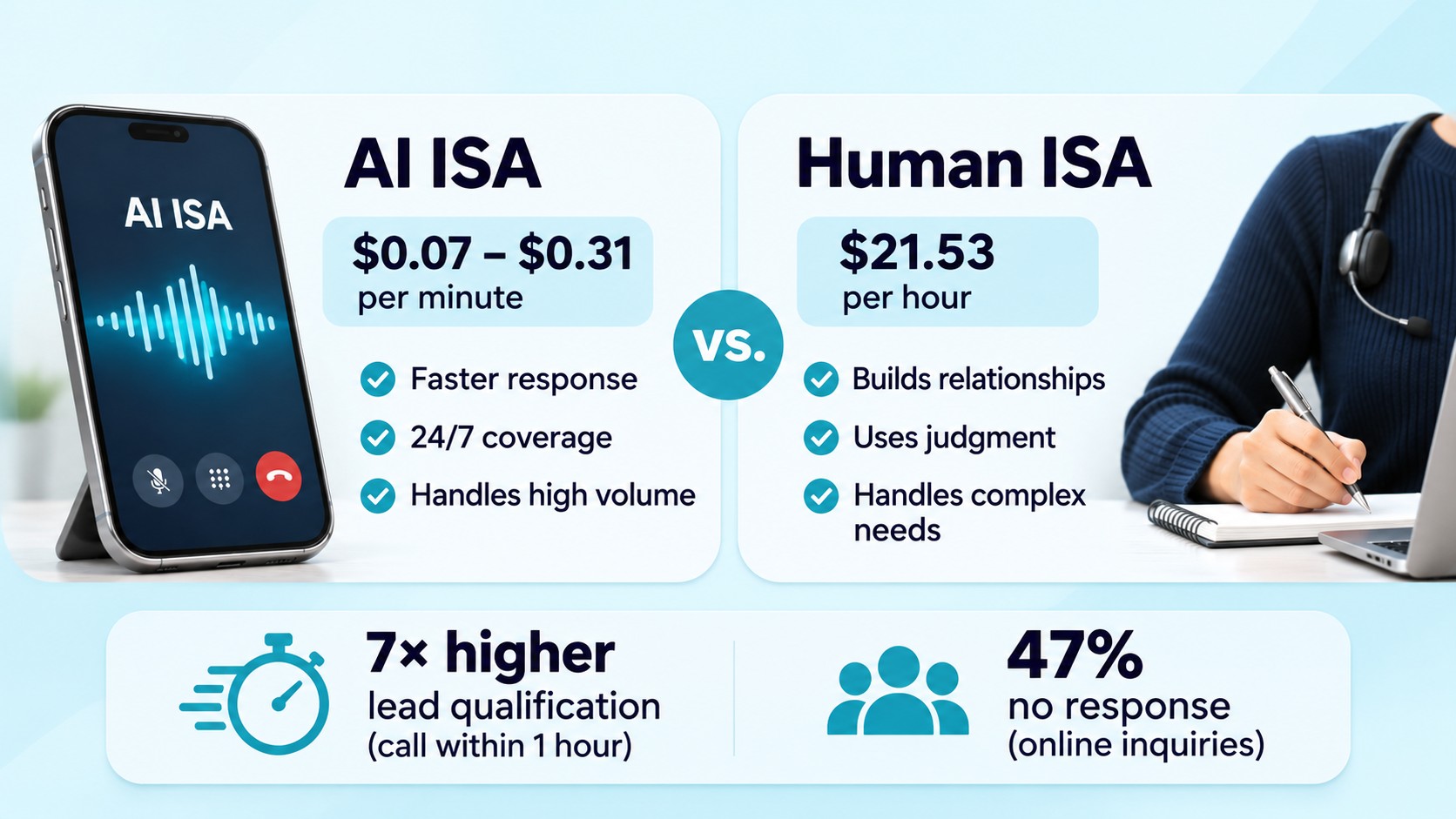
Where an AI ISA wins, where a human ISA wins, and what each costs.
What does each cost?
They are priced so differently that a direct comparison takes a little work.
A person is paid by the hour. The Bureau of Labor Statistics reports median pay of $21.53 an hour, or $44,770 a year, for customer service representatives as of May 2025. (U.S. Bureau of Labor Statistics) That is a rough proxy for ISA base pay. Bonuses, payroll taxes, benefits, and the time you spend recruiting and coaching sit above it.
AI is paid for by use. One developer platform, Retell AI, lists $0.07 to $0.31 per minute, and its calculator defaults to about $0.11. (Retell AI) At that default, an hour of actual conversation is $6.60 in raw usage. Finished products cost more than raw usage because they include the integrations and compliance handling. Some charge by result instead, such as $35 per live transfer. (Ylopo)
The useful comparison is cost per kept appointment. Take a month of total cost for each approach and divide by appointments that happened.
Where does a person still win?
In conversations that need reading between the lines.
A person is stronger
- A seller who is grieving or under financial stress
- Negotiating around an objection the script never anticipated
- Luxury and referral clients who expect a personal touch
- Deciding that a “no” is really a “not yet”
AI is stronger
- Calling every new lead in seconds
- Evening and weekend inquiries
- The seventh follow-up attempt, made as carefully as the first
- Logging every call the same way
Consumer research supports the split. In Invoca’s 2026 survey, 49% of buyers preferred AI for simple tasks, and 96% said human connection matters in a high-stakes purchase. (Invoca) That is roughly the line between a first qualifying call and a listing conversation. We look at the surveys in do callers mind talking to AI.
How do teams combine them?
By giving each one the part of the day it is good at. A typical arrangement has five steps.
- AI makes the first call Every new lead is called within seconds and asked your qualifying questions.
- Ready leads are transferred live The AI keeps the lead on the line while it briefs your ISA or agent, then connects them.
- Everyone else gets a next step Either a booked time or a place in a follow-up cadence.
- AI works the long tail Old leads and no-answers get calls and texts on a schedule nobody has to remember.
- People review and tune Someone listens to recordings each week and adjusts the questions.
In this setup the human ISA’s day changes. Less of it is spent dialing people who do not answer. More goes to live conversations with leads who have already said yes to talking. The handoff itself is described in how AI warm transfer works.
Hear the transfer your ISA would get Book a demo and take a live warm transfer. You will hear the brief first, then the lead. Book a demo
Which should you choose?
| Your situation | A reasonable choice |
|---|---|
| A solo agent or small team with no ISA | AI for first contact, with transfers to you |
| A team with one ISA who is buried in new leads | AI in front, with the ISA taking transfers |
| A large team with a trained ISA department | People for live work, AI for after hours and old leads |
| Mostly referral and repeat business | A person, since volume is low and relationships matter |
| Heavy portal and ad lead volume | AI first, because speed decides those leads |
Whatever you choose, check consent before any AI call goes out. Our guide to the TCPA for real estate teams covers what is required, and the roundup of AI voice agents for real estate compares products.
Let people do the people part Try VerbaCall free with 30 minutes of call time, or book a demo to hear a first call and a warm transfer. Book a demo or Try for free
We make VerbaCall, so read this comparison with that in mind. Details about other products come from their public pages as of November 2026. Check each vendor for current features and pricing.
Frequently asked questions
What does ISA stand for in real estate?
Inside sales agent. An ISA contacts new and existing leads by phone and text. The job is to qualify them and set appointments for the agents who will meet the client. ISAs usually do not show homes or write offers.
Is an AI ISA cheaper than a human ISA?
Per attempt, yes. Raw AI call time is priced in cents per minute, while a person is paid for every hour of a shift whether leads answer or not. (Retell AI) (U.S. Bureau of Labor Statistics) The fair comparison is cost per appointment set, which depends on your lead quality. Our payback worksheet shows how to calculate it.
Can an AI ISA replace a human ISA?
It can replace the dialing and the first two minutes of qualification. It does not replace someone who can talk a nervous seller through a pricing conversation. Teams that already have a strong ISA tend to keep that person and move them onto transfers and callbacks.
Do leads hang up when they realize it is AI?
Some do. In a 2026 survey, 59% of consumers said they prefer a human when both are available. (CX Foundation) In separate research, 59% said they would accept a proactive call from an AI agent if they could reach a person. (No Jitter) Disclosure and a quick route to a human both matter.
How do you measure an ISA, human or AI?
With the same numbers: time to first call, contact rate, appointments set, appointments kept, and cost per kept appointment. Compare them over the same lead sources and the same weeks.
Sources
- U.S. Bureau of Labor Statistics, May 2025 data. Customer Service Representatives, Occupational Outlook Handbook
- Retell AI, accessed November 2026. Pricing
- Ylopo, accessed November 2026. Database Ignite
- Harvard Business Review, March 2011. The Short Life of Online Sales Leads
- Mike DelPrete, August 2024. Secret Shopping: 47% of Online Property Inquiries Are Ignored
- Federal Communications Commission, February 2024. FCC Confirms TCPA Applies to AI Technologies That Generate Human Voices
- National Association of REALTORS, March 2025. TCPA Best Practices One-Sheet
- CX Foundation, June 2026. Coverage of Invoca’s 2026 B2C Buyer Experience Report
- Invoca, 2026. AI in Customer Experience: What 700 Buyers Told Us in 2026
- No Jitter, reporting Metrigy research, August 2026. Consumers warming to AI customer service agents
About VerbaCall. VerbaCall is an AI voice agent platform. It calls new leads within about 20 seconds, answers inbound calls at any hour, books appointments, and warm-transfers ready callers to your team. Each conversation is written back to your CRM, with text and email follow-up alongside. It is built on Twilio and serves US businesses in real estate, senior living, home care, healthcare, and restaurants. See how VerbaCall works.