How to Choose an AI Voice Agent: 12 Questions to Ask Every Vendor
Twelve questions for evaluating an AI voice agent, grouped by the call, the handoff, compliance, and cost, with a scorecard you can reuse.
On this page
- Key takeaways
- What should you test on the call itself?
- What should you ask about the handoff and the record?
- What should you ask about compliance?
- What should you ask about cost and setup?
- How do you score the answers?
- What are the red flags?
- What matters less than it seems?
- Frequently asked questions
- Sources
Quick answer: To choose an AI voice agent, test it on a live call to your own phone. Check how fast it responds, how it copes when you go off script, how it hands you to a person, and what it writes to your CRM. Then confirm how it handles consent and opt-outs, and price it against your own monthly minutes.
Key takeaways
- A demo on your own phone tells you more than a feature list. Insist on one.
- The handoff to a person is where products differ most, so listen to what your staff would hear before the caller is connected.
- 83% of consumers say an AI agent should identify itself. Check that the agent does. (CX Foundation)
- Outbound AI calls need prior consent under the TCPA. Ask how the product checks it. (Federal Communications Commission)
What should you test on the call itself?
Test four things. All of them can be checked in one demo, on your own phone, with a test lead you create.
| Question | A good answer | How to test it |
|---|---|---|
| 1. How quickly does it call a new lead? | Seconds | Submit a form and time it until your phone rings |
| 2. What happens when I interrupt? | It stops and listens, then picks up the thread | Cut in mid-sentence with a different question |
| 3. Does it say it is an AI? | Yes, in its first sentence | Listen to the greeting |
| 4. What does it do when it does not know? | It says so and offers a person or a callback | Ask something outside its script |
Speed has the strongest evidence behind it. Companies that reached a lead within an hour were nearly seven times as likely to qualify it as those that waited an hour longer, according to a Harvard Business Review study. (Harvard Business Review)
The third question is about trust. In a 2026 survey, 83% of consumers said an AI agent should identify itself. (CX Foundation) An agent that hides what it is creates a problem you will hear about later.
What should you ask about the handoff and the record?
Ask four more questions here. These decide whether the product saves your team time or creates cleanup work.
5. Can it transfer a caller to a person, and what does that person hear first?
The better products hold the caller while they ring your staff member, then give a short spoken summary before connecting. A blind transfer makes the caller repeat everything. See how AI warm transfer works.
6. What happens when nobody picks up the transfer?
There should be a fallback, such as booking a callback or taking a message, and the caller should be told what will happen.
7. What gets written to my CRM?
Ask to see the record after a test call. Look for a summary and the outcome on the right contact, with a link to the recording.
8. Can it book on my real calendar?
It should offer open slots only and create the event where your team will see it.
VerbaCall briefs you on a second line before connecting the caller, and writes the summary to your CRM. Hear a live call
What should you ask about compliance?
Two questions, each with a wrong answer that is expensive.
Question 9 is how the product checks consent before an outbound call and how it handles opt-outs. The FCC treats AI-generated voices as artificial under the TCPA, which means outbound AI calls need prior consent. (Federal Communications Commission) Ask where consent is recorded, and watch an opt-out request suppress the number. Our article on whether AI voice calls are legal explains the rules.
Question 10 is how recordings are stored and what agreements the vendor will sign. Federal law allows recording with one party’s consent, while about 11 states require everyone’s. (Reporters Committee for Freedom of the Press) If you are a HIPAA covered entity, you also need a written business associate agreement with the vendor. (U.S. Department of Health and Human Services)
A vendor’s features support compliance. They do not transfer the responsibility. The consent you collect is still yours to get right.
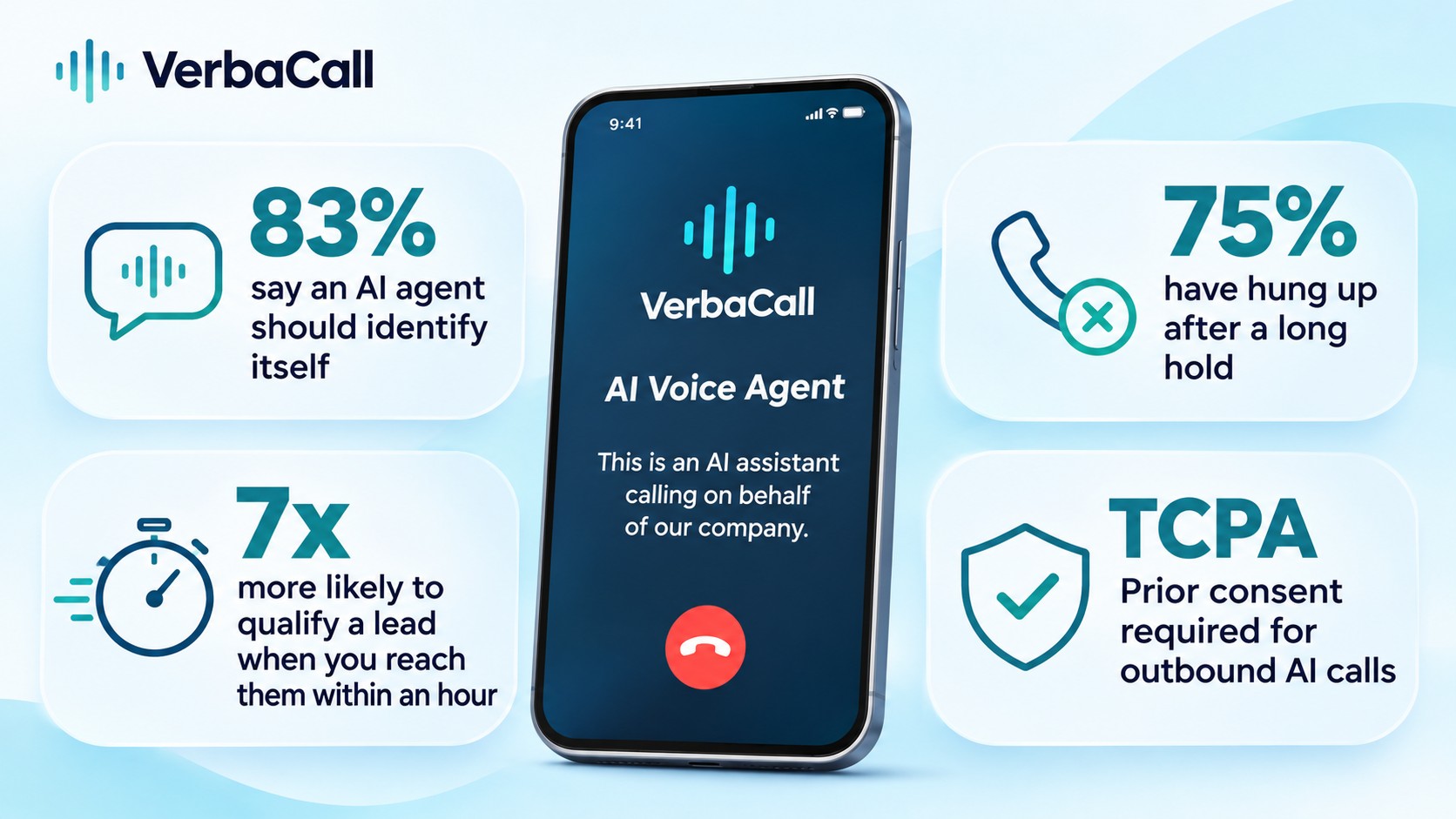
Four facts to test every vendor against.
What should you ask about cost and setup?
The final two questions cover cost and setup.
| Question | What to listen for |
|---|---|
| 11. What will I pay at my volume, and what counts as a billable minute? | A written quote against your estimated minutes, with overage and message charges stated |
| 12. How long does setup take, and who does it? | A date and a named owner on the vendor’s side, plus a list of what you must supply |
Bring your own minute estimate to this conversation. Our pricing guide shows how to calculate one.
How do you score the answers?
Score them with a one-page scorecard, filled in straight after each demo. Rate every row from 1 to 5.
| Criterion | What a 5 looks like |
|---|---|
| Speed to first call | Your phone rang within a minute of the test lead |
| Conversation quality | It handled an interruption and an off-script question |
| Handoff | You heard a useful brief before the caller was connected |
| CRM record | A summary and the recording, on the right contact |
| Compliance | Consent check and opt-out shown working |
| Cost at your volume | A written quote with no undefined fees |
Weight the rows by your situation. A senior living community may count the handoff twice, since families remember it. A high-volume brokerage may do the same with speed.
Run this scorecard on us Book a demo and bring the 12 questions. We will answer each one on a live call. Book a demo
What are the red flags?
Five signs that a product or a sales process will disappoint.
- The demo is a recording, and you cannot call the agent yourself.
- The salesperson quotes conversion gains with no source or sample size.
- Nobody can show you an opt-out working.
- The CRM integration is described as “coming soon” for your system.
- You are asked to sign a long contract before any trial.
The second one is common. Averages across a vendor’s customers say little about your leads. Ask for a trial and measure it.
What matters less than it seems?
Voice variety and long feature lists matter less than they seem. Most businesses will use one voice and one or two call flows. People are forgiving of a voice that is pleasant and clear. They are much less forgiving of being kept waiting, and 75% of consumers in one 2026 survey said they had hung up after a long hold. (Invoca)
Spend your evaluation time on the twelve questions. Once you have chosen, our 30-day rollout plan covers what to do next. For shortlists, see the roundups for real estate and senior living.
Ask us all twelve Try VerbaCall free with 30 minutes of call time, or book a demo and bring the scorecard. Book a demo or Try for free
Frequently asked questions
What is the most important thing to test?
The handoff. Ask the agent for a person in the middle of a call and pay attention to what happens next. A good product briefs your staff member before connecting, and has a plan when nobody is free.
Should I choose a product built for my industry?
Industry fit helps with CRM connectors and with wording that suits your customers. It matters less than how the product performs on a call. A general platform with a ready-made agent for your field and a connector for your CRM can serve as well as a specialist.
How many vendors should I compare?
Two to four is plenty. Give each the same test call and the same scorecard. More than that and the calls blur together.
Do I need a developer to set one up?
Not for a packaged product with a connector for your CRM. You will need one for developer platforms, where you assemble the agent yourself. Our build or buy guide explains the difference.
How long should a trial run?
Long enough to hear a few dozen real calls. For a team with steady lead flow, that often takes about two weeks. Judge on calls you have listened to, and ignore the dashboard until you have.
Sources
- CX Foundation, June 2026. Coverage of Invoca’s 2026 B2C Buyer Experience Report
- Federal Communications Commission, February 2024. FCC Confirms TCPA Applies to AI Technologies That Generate Human Voices
- U.S. Department of Health and Human Services. Are You a Covered Entity?
- Reporters Committee for Freedom of the Press. Introduction to the Reporter’s Recording Guide
- Harvard Business Review, March 2011. The Short Life of Online Sales Leads
- Invoca, 2026. AI in Customer Experience: What 700 Buyers Told Us in 2026
About VerbaCall. VerbaCall is an AI voice agent platform. It calls new leads within about 20 seconds, answers inbound calls at any hour, books appointments, and warm-transfers ready callers to your team. Each conversation is written back to your CRM, with text and email follow-up alongside. It is built on Twilio and serves US businesses in real estate, senior living, home care, healthcare, and restaurants. See how VerbaCall works.