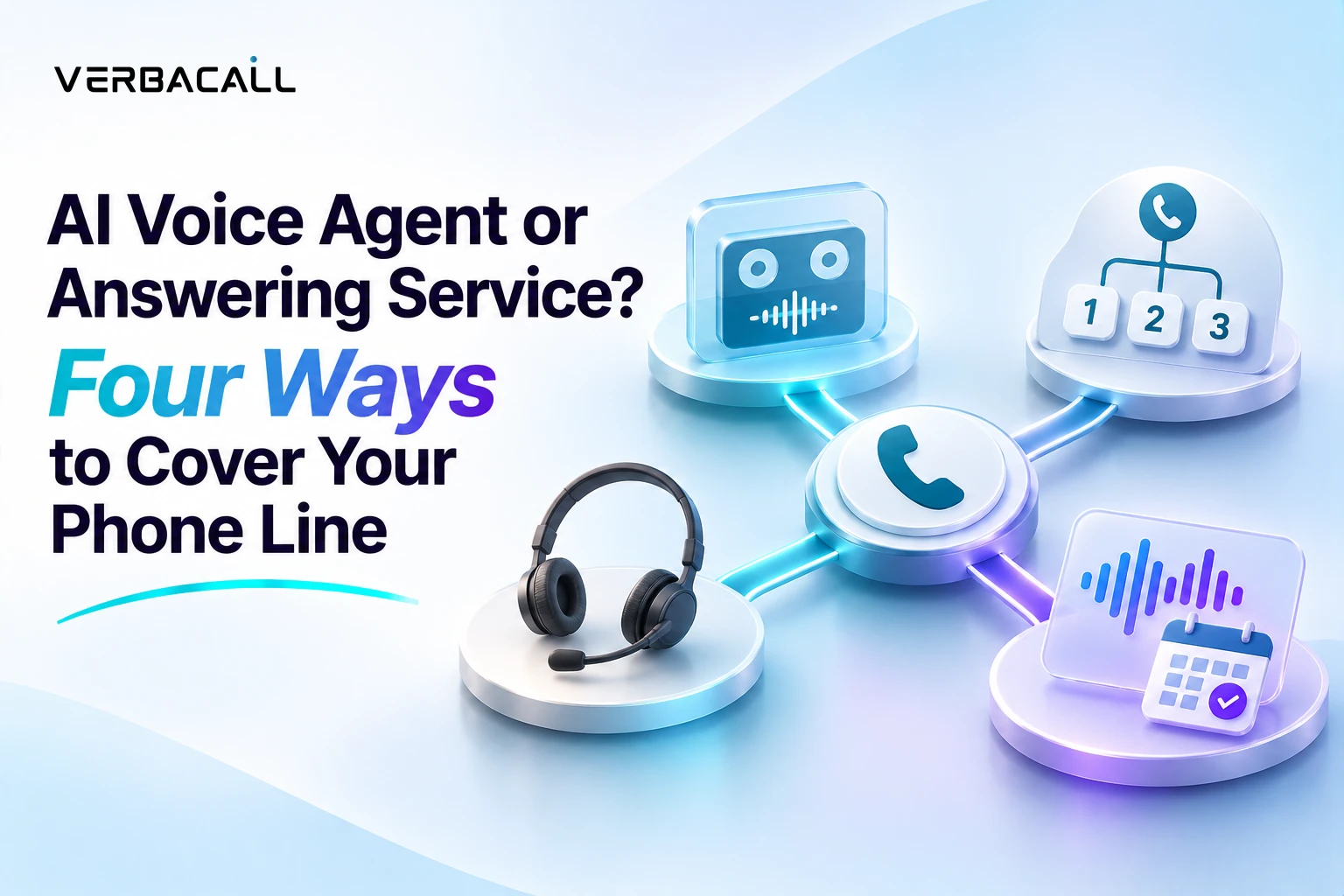
AI Voice Agent or Answering Service? Four Ways to Cover Your Phone Line
Four ways to cover a business phone line compared on cost and capability, with published answering service prices and 2026 caller surveys.
On this page
- Key takeaways
- What are the four ways to cover a phone line?
- What does a human answering service cost?
- What does an AI voice agent cost?
- Where does a human service still win?
- What do callers think?
- What about calls you need to make?
- How do businesses combine AI and people?
- Which should you choose?
- Frequently asked questions
- Sources
Quick answer: An answering service puts a person on your line to take messages or follow a script, usually billed per call. An AI voice agent answers instantly and can book appointments and update your CRM. It is billed by usage or plan. Human services suit a small number of delicate calls. AI suits high volume and after-hours coverage, and it can also call leads back, with a person available on transfer.
Key takeaways
- One human answering service, Smith.ai, lists plans from $300 a month for 30 calls to $2,100 for 300 calls. That works out to $7 to $10 per call. (Smith.ai)
- Raw AI call time on one developer platform defaults to about $0.11 a minute, before the cost of a finished product. (Retell AI)
- In a 2026 survey, 75% of consumers said they had hung up after a long hold, up from 50% the year before. (Invoca)
- 59% prefer a human when both are available, so any AI setup needs a quick path to a person. (CX Foundation)
What are the four ways to cover a phone line?
Every business ends up with one of these, or a mix. They differ most in what happens after the greeting.
| Voicemail | Phone tree | Human answering service | AI voice agent | |
|---|---|---|---|---|
| Answers right away | No | Yes, with a menu | Yes, when an agent is free | Yes |
| Answers questions about your business | No | No | From a script | From the information you provide |
| Books appointments | No | No | Varies by provider | Yes, on your calendar |
| Makes outbound calls to new leads | No | No | Varies by provider | Yes |
| Writes to your CRM | No | No | Varies | Yes |
| Hours | Always | Always | Depends on plan | Always |
| Billing | Free | Low monthly fee | Per call or per minute | By usage or plan |
Voicemail is on the list because it is still the default. In mystery shops of senior living communities during 2023, 17% of callers were transferred to voicemail without warning. (Senior Housing News) Across senior care, a person answers only 53% of inbound calls. (Invoca)
What does a human answering service cost?
Prices vary by provider. Smith.ai publishes its rates, which makes it a useful reference. (Smith.ai)
| Plan | Monthly price | Calls included | Cost per call |
|---|---|---|---|
| Starter | $300 | 30 | $10.00 |
| Basic | $810 | 90 | $9.00 |
| Pro | $2,100 | 300 | $7.00 |
Calls beyond the Starter allowance cost $11.50 each. (Smith.ai) The model is easy to understand and fair for what it buys, which is a trained person on every call.
The bill grows with every call. A business that receives 300 calls a month pays seven times what a business with 30 calls pays. Spam and wrong numbers may be handled differently by each provider, so ask how they are counted.
VerbaCall answers every call at any hour and books the appointment, with a warm transfer to your team when a caller wants a person. See how it works
What does an AI voice agent cost?
Less per call, with a different shape. The underlying technology is billed by the minute. Retell AI, a developer platform, shows a default of about $0.11 per minute in its calculator. (Retell AI) A three-minute call at that rate is 33 cents.
Finished products cost more than raw usage. They include the integrations and the compliance handling, and they usually price by plan. VerbaCall’s plans are sized by number of agents and included minutes. Our guide to AI voice agent pricing explains the models.
The shape matters as much as the rate. Usage-based AI costs also grow with volume, at cents per minute instead of dollars per call.
Where does a human service still win?
In a narrower set of situations than it used to, though they are real ones.
A person is the better choice
- A handful of calls a month, each one high in value
- Callers in distress, such as legal or medical emergencies
- A brand promise that a person answers every call
- Conversations that wander far from any script
An AI agent is the better choice
- High or unpredictable call volume
- Nights and weekends
- Booking and rescheduling appointments
- Calling new leads back within seconds
Emotional weight is the clearest dividing line. A trained receptionist adapts to a caller who is upset in ways AI still handles unevenly.
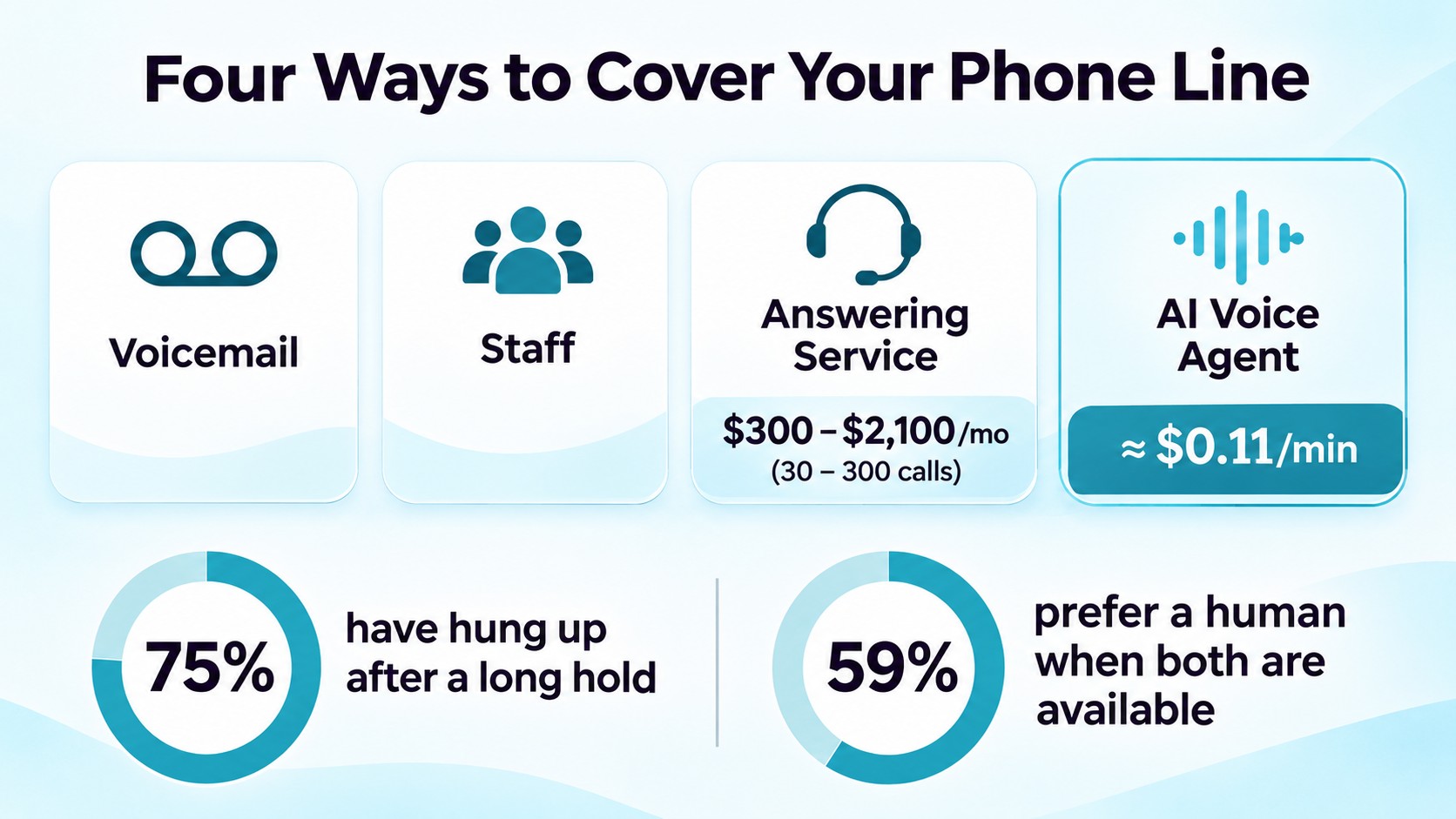
Four ways to cover your phone line, with published prices and caller preferences.
What do callers think?
They want speed, and many still want a person. Both findings come from 2026 surveys.
Caller attitudes in 2026
| Number | What it measures | Source |
|---|---|---|
| 75% | Consumers who hung up after a long hold, up from 50% a year earlier | Invoca |
| 49% | Consumers who prefer AI for simple tasks | Invoca |
| 59% | Consumers who prefer a human when both are available | CX Foundation |
| 83% | Consumers who say an AI agent should identify itself | CX Foundation |
Read together, the numbers favor a setup where AI answers at once and a person is close behind. What callers dislike is waiting, along with being trapped with no way out. More detail is in do callers mind talking to AI.
What about calls you need to make?
This is where the two differ most. Answering services are built to answer. Some offer outbound callbacks as an extra, billed per call, so ask if you need them.
An AI voice agent works in both directions by design. With VerbaCall, a new lead in your CRM triggers an outbound call within about 20 seconds. If lead response is your main problem, you are comparing an AI agent against hiring someone to make calls, which is a separate decision. See AI ISA versus human ISA.
Call it yourself Book a demo and phone the agent as a customer would. Ask for a person halfway through to hear the handoff. Book a demo
How do businesses combine AI and people?
Most combine them in layers, with the AI in front.
- The AI answers every call No hold music and no menu. It says it is an AI assistant and asks how it can help.
- Routine requests are finished on the call Appointments and messages, plus any question it has an answer for.
- Callers who need a person are transferred The agent briefs your staff member first, then connects the caller.
- After hours, it books and logs The caller gets an appointment or a callback time, and your team sees a summary in the morning.
The handoff in the third step is the part to test hardest. Our explainer on AI warm transfer describes what should happen.
Which should you choose?
| Your situation | Reasonable choice |
|---|---|
| Under 30 calls a month, each one valuable | Human answering service |
| Calls go to voicemail every evening | AI voice agent |
| A front desk that is overloaded at peak times | AI voice agent as overflow, with transfers |
| New web leads wait hours for a call | AI voice agent with outbound calling |
| Only need calls routed to the right department | Phone tree |
Before you sign with any vendor, work through the questions in how to choose an AI voice agent.
Answer every call, at any hour Try VerbaCall free with 30 minutes of call time, or book a demo to hear it take a call. Book a demo or Try for free
We make VerbaCall, so read this comparison with that in mind. Details about other products come from their public pages as of November 2026. Check each vendor for current features and pricing.
Frequently asked questions
Is an AI voice agent cheaper than an answering service?
Per call, usually. A human service on Smith.ai’s published plans costs $7 to $10 per call. (Smith.ai) A three-minute AI call is about 33 cents of raw usage at one platform’s default rate, and finished AI products add their own margin on top. (Retell AI) Compare quotes against the same monthly call count.
Can an AI agent take a message like a receptionist?
Yes, and it can usually do more than that. It can answer common questions from the information you give it and book an appointment on your calendar. It also writes a summary to your CRM. Taking a message is the fallback when nothing else fits.
Will callers know they are talking to AI?
They should, because the agent should say so. In a 2026 survey, 83% of consumers said an AI agent should identify itself. (CX Foundation) A clear introduction and an easy route to a person prevent most complaints.
Is a phone tree good enough?
For routing between departments, yes. For a new customer who wants an answer, it adds steps and still ends at a person or a voicemail box. It cannot book anything or answer a question.
Can I keep my answering service and add AI?
Yes. A common arrangement has the AI answer first and transfer to your staff when a caller needs a person. Some businesses keep a human service as overflow for the calls nobody on staff can take.
Sources
- Smith.ai, accessed November 2026. Pricing
- Retell AI, accessed November 2026. Pricing
- Invoca, 2026. AI in Customer Experience: What 700 Buyers Told Us in 2026
- CX Foundation, June 2026. Coverage of Invoca’s 2026 B2C Buyer Experience Report
- Senior Housing News, February 2024. Senior Living Operators Level Up Sales to Beat ‘Alarming’ Trends in Conversions
- Invoca, July 2026. The Senior Care Lead Conversion Benchmarks Report
About VerbaCall. VerbaCall is an AI voice agent platform. It calls new leads within about 20 seconds, answers inbound calls at any hour, books appointments, and warm-transfers ready callers to your team. Each conversation is written back to your CRM, with text and email follow-up alongside. It is built on Twilio and serves US businesses in real estate, senior living, home care, healthcare, and restaurants. See how VerbaCall works.