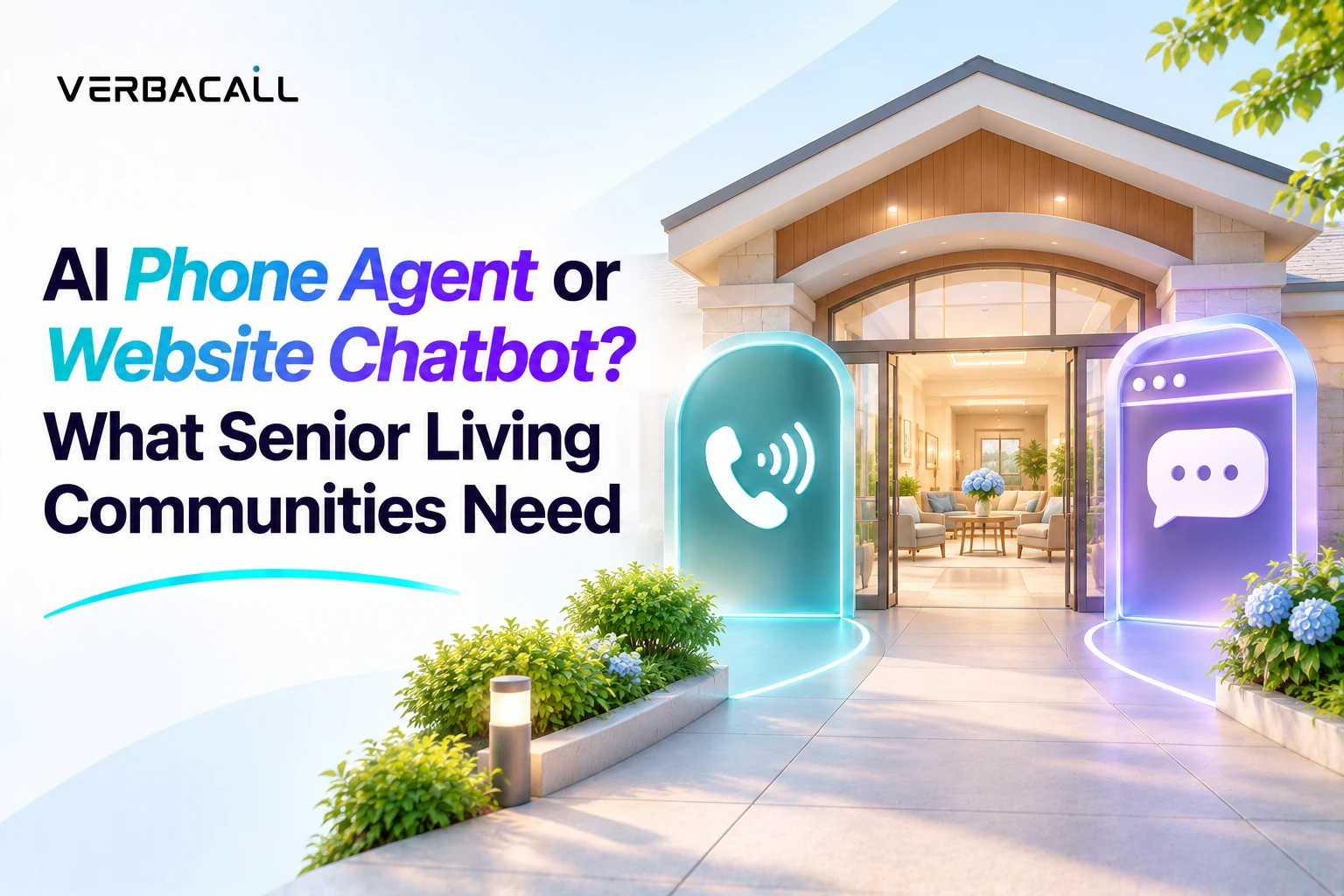
AI Phone Agent or Website Chatbot? What Senior Living Communities Need
A website chatbot and an AI phone agent do different jobs in senior living. See how each channel converts and which gap to close first.
On this page
Quick answer: A website chatbot captures visitors who would rather type than call. An AI phone agent answers callers and can call web inquiries back. In senior living both channels convert well once a conversation happens, so the choice depends on where families are going unanswered. A person answers only 53% of inbound senior care calls, which makes the phone the larger gap for many communities.
Key takeaways
- About 72% of senior living inquiries arrive digitally, yet call-in inquiries lead to tours 42% to 58% of the time. (MatrixCare and Aline) (Aline)
- A person answers only 53% of inbound calls to senior care providers. (Invoca)
- 52% of Baby Boomers prefer calling when they need help. (Invoca)
- A chatbot cannot pick up the phone, and a phone agent cannot greet a website visitor. Decide which unanswered family is costing you more.
What does each one do?
They sit at different doors of the same building.
| Website chatbot | AI phone agent | |
|---|---|---|
| Where it works | On your website | On your phone line |
| Who it serves | Visitors who are browsing | People who call, and web inquiries that need a callback |
| How people use it | Typing | Speaking |
| Typical result | A captured name and number, sometimes a booked tour | A booked tour or a transfer to a counselor |
| After hours | Yes | Yes |
| Outbound | No | Yes, where the product supports it |
The last row is easy to miss. A chatbot waits for a visitor. A phone agent can also start the contact, by calling a family minutes after they submit a form.
Who uses which channel?
It follows the person and the moment. An adult daughter comparing communities at 11 p.m. is on a laptop and may be glad to type. Her father, calling on his own behalf the next afternoon, wants to hear a voice.
Survey data fits that picture. In Invoca’s 2026 consumer research, 41% of all respondents preferred calling when they needed help, and 52% of Baby Boomers did. (Invoca) The same research found that 96% of buyers consider human connection important in a high-stakes purchase. (Invoca) Few purchases carry higher stakes than a parent’s care.
There is a newer route to the phone as well. Invoca reports that calls from people referred by ChatGPT had a 38% lead rate. (Invoca) Families who research with AI assistants still end up dialing.
How do the channels convert?
Both channels convert well when someone responds. The weak point in both is the response itself.
Channel performance in senior living
| Number | What it measures | Source |
|---|---|---|
| 51% to 57% | Website inquiries that led to a tour in Q2 2026, by care type | Aline |
| 42% to 58% | Call-in inquiries that led to a tour in the same quarter | Aline |
| 53% | Inbound senior care calls answered by a person | Invoca |
| 53% | Web inquiries with no response after two hours, in 2023 mystery shops | Senior Housing News |
Look at the two halves separately. The top rows say families from either channel are serious. The bottom rows say about half of them are left waiting.
That shifts the question. A chatbot adds a new way to inquire. It does nothing for the call that rings out at 6 p.m. or the web form that sits until morning.
VerbaCall answers your inquiry line at any hour and calls web inquiries back within about 20 seconds. See it for senior living
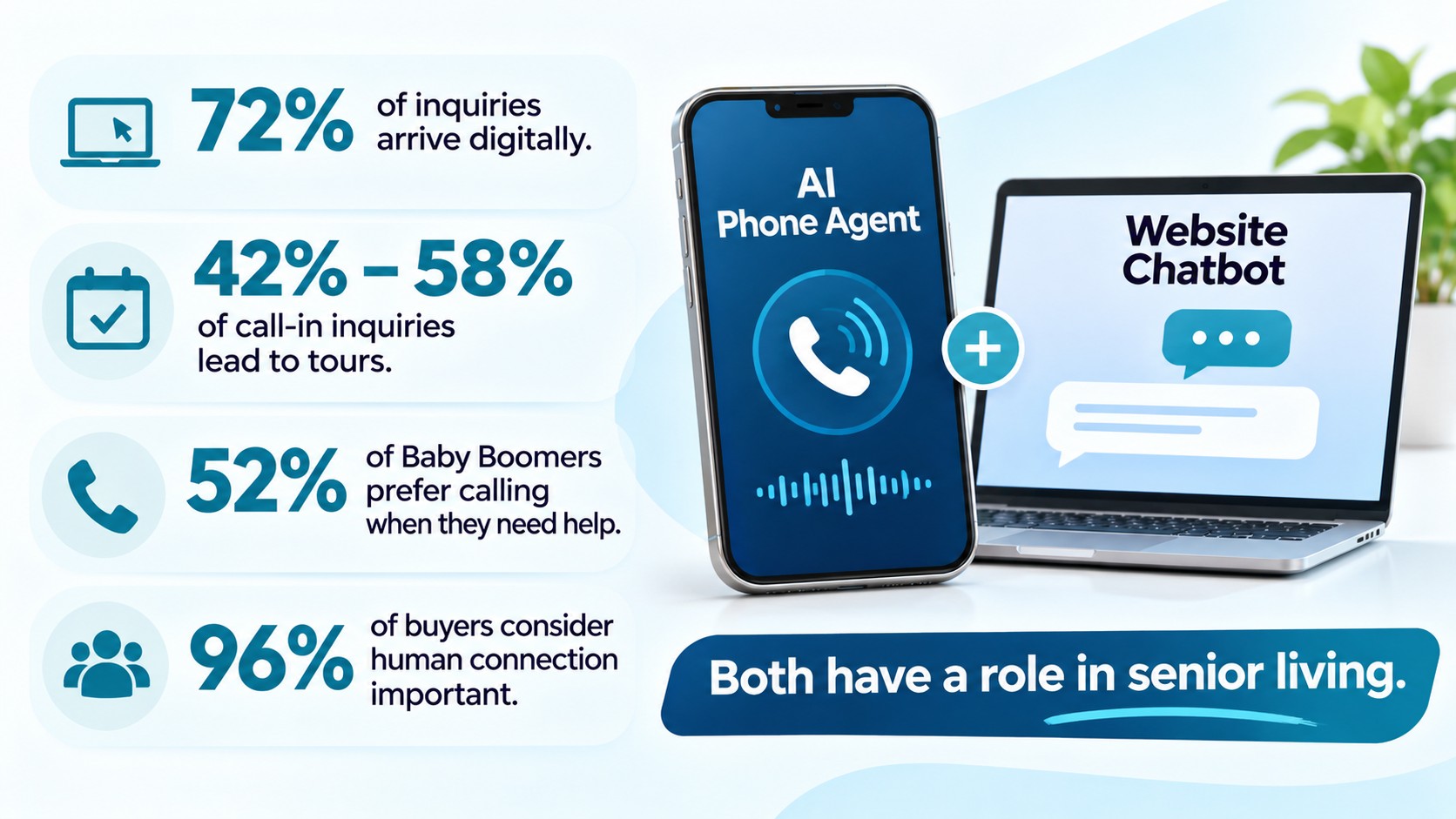
Most inquiries start online, but calls convert. Both channels have a role.
What are the limits of each?
A chatbot cannot
- Answer a ringing phone
- Call a family back after a form is submitted
- Convey warmth through tone of voice
- Hand a live caller to your counselor
A phone agent cannot
- Engage someone who is only browsing
- Show photos or floor plans
- Help a visitor who does not want to talk
- Replace the tour or the counselor
Neither one closes a move-in. Each gets a family to a person sooner.
Which gap should you close first?
Find where families are going unanswered. Your own records will tell you.
| What your data shows | Start with |
|---|---|
| Calls reach voicemail in the evening or at weekends | An AI phone agent on the inquiry line |
| Web forms wait more than an hour for a call | An AI phone agent that calls back |
| Plenty of website traffic and few inquiries | A website chatbot |
| The front desk is pulled away from calls during the day | An AI phone agent as overflow |
| All of the above | Phone first, since those families have already raised a hand |
The reasoning behind the last row is simple. A caller and a form-filler have both asked for contact. A browsing visitor has not yet. Serving the people who already asked comes before finding more of them.
Timestamps make this concrete. Pull a month of calls and web inquiries and mark how long each waited for a person. Count the ones that never got a reply. Our guide to senior living speed to lead shows how.
Test your own phone line first Book a demo, then call your community at 7 p.m. and compare what a family hears with what the agent would say. Book a demo
How do they work together?
In sequence, when a community has both.
- The chatbot captures the visitor It answers basic questions and collects a name and number, with consent to be contacted.
- The phone agent calls back Within seconds, while the family is still thinking about it.
- The tour is booked on the call The agent offers times from the counselor’s calendar.
- The counselor gets a summary What the family asked in chat and said on the phone arrives in one record.
For that to work, both tools need to write to the same CRM. Two systems with separate records will have your team asking families to repeat themselves.
VerbaCall covers every step after the first. It does not provide website chat, so a community that wants both would pair it with a chat tool or look at a suite. We compare one in VerbaCall vs. Further, and cover the broader case in voice AI for senior living.
Start with the families who called Try VerbaCall free with 30 minutes of call time, or book a demo to hear an inquiry call and a callback. Book a demo or Try for free
We make VerbaCall, so read this comparison with that in mind. Details about other products come from their public pages as of November 2026. Check each vendor for current features and pricing.
Frequently asked questions
Is an AI phone agent just a chatbot with a voice?
- A scripted chatbot follows a decision tree, while a conversational AI agent understands free-form speech and can take actions such as booking a tour. Our earlier post on AI versus chatbots explains the difference.
Do older adults use website chat?
Some do, and the person inquiring is often an adult child. Preference still leans toward the phone in older age groups. In a 2026 survey, 52% of Baby Boomers said they prefer calling when they need help. (Invoca)
Which converts better, chat or phone?
Aline’s data does not separate chat from other website inquiries. It shows website inquiries touring at 51% to 57% and call-ins at 42% to 58%, depending on care type. (Aline) Both are strong once the family reaches someone.
Can one vendor provide both?
Some do. Further lists both AI Web Conversations and AI Phone Agents. (Further) VerbaCall handles phone calls, with text and email follow-up. It is not a website chat product.
What about text messaging?
Texting sits between the two. It suits confirmations and reminders, and families who prefer not to talk. It needs consent and carrier registration, covered in our 10DLC guide.
Sources
- Aline, 2026. Q2 2026 Sales and Marketing Benchmark Snapshot
- MatrixCare and Aline, August 2026. Executive brief citing Aline’s Annual Benchmark Report 2026
- Invoca, July 2026. The Senior Care Lead Conversion Benchmarks Report
- Invoca, 2026. 2026 Report: Consumers Embrace AI, Demand for Fast Responses from Brands Increases
- Invoca, 2026. AI in Customer Experience: What 700 Buyers Told Us in 2026
- Senior Housing News, February 2024. Senior Living Operators Level Up Sales to Beat ‘Alarming’ Trends in Conversions
- Further, accessed November 2026. Product overview
About VerbaCall. VerbaCall is an AI voice agent platform. It calls new leads within about 20 seconds, answers inbound calls at any hour, books appointments, and warm-transfers ready callers to your team. Each conversation is written back to your CRM, with text and email follow-up alongside. It is built on Twilio and serves US businesses in real estate, senior living, home care, healthcare, and restaurants. See how VerbaCall works.