How to Re-Engage Lost Leads in Senior Living
A playbook for re-engaging lost and stalled senior living leads, from segmenting by lost reason to measuring what comes back at 90 days.
On this page
Quick answer: Lead reactivation in senior living means reaching back out to families who inquired or toured and then went quiet. Needs change after a health event or a hard winter, so a respectful check-in months later often finds a family ready to talk. Segment by why the lead stalled and confirm consent before any automated outreach. Keep it to a few gentle touches.
Key takeaways
- A lost lead in senior living is often a delayed one. The need behind the inquiry rarely goes away.
- Segment by lost reason. “Not ready yet” and “chose another community” call for different messages.
- Aline’s automated outbound product makes up to 20 attempts over 90 days on new inquiries, a sign of how much persistence the industry now treats as normal. (Aline via PR Newswire)
- Remove anyone who has passed away or asked not to be contacted before a single call goes out.
- Judge results at 90 days. Reactivated families move slowly at first.
Why do senior living leads go quiet?
Usually because the family is not ready, which is different from not interested. A parent resists the idea. Siblings disagree. A health scare passes and the urgency fades with it.
The numbers show how common this is. Aline’s 2026 benchmark report puts inquiry-to-move-in at about 4.3%. (MatrixCare and Aline) Put the other way, the great majority of inquiries in any CRM did not move in. Some chose elsewhere. Many are still at home, a little older, with the same question unresolved.
Sales cycles are long even for families who say yes. WelcomeHome’s data shows about 13 touches between a tour and a move-in. (WelcomeHome Senior Care Insights) A lead that went quiet after two calls was not worked to the end. It was set down.
Which leads are worth re-engaging?
Most lost leads are worth re-engaging, with different approaches. Sort by the reason the lead stalled, which your CRM should hold as a lost reason or a last note.
| Lost reason | Contact again? | Opening angle |
|---|---|---|
| Not ready yet | Yes, after 60 to 90 days | Ask how things are going at home |
| Cost concerns | Yes | Share any new pricing options or financial resources |
| Chose home care or family care | Yes, after several months | Ask whether the arrangement is still working |
| Chose another community | Once, after six months or more | A brief, courteous check-in |
| Never connected | Yes | Reintroduce the community and ask if they are still looking |
| Passed away, or asked for no contact | Never | Remove from every list |
Take the last row seriously. Review notes before any campaign, and suppress those records first.
VerbaCall can work a filtered list of older inquiries with calls and follow-up messages, then hand interested families to your counselor. See it for senior living
Do you have consent to reach out?
Check before anything automated goes out. Outbound calls that use an AI voice need the person’s prior consent, since the FCC treats AI-generated voices as artificial under the TCPA. (Federal Communications Commission) Marketing texts need consent as well. A counselor dialing by hand has more latitude, though Do Not Call rules still apply.
Sort your list accordingly. Records with documented consent can go into an automated sequence. The rest get a personal call or are left out. If your organization is covered by HIPAA, the health details in old notes add another layer, which our HIPAA guide explains.
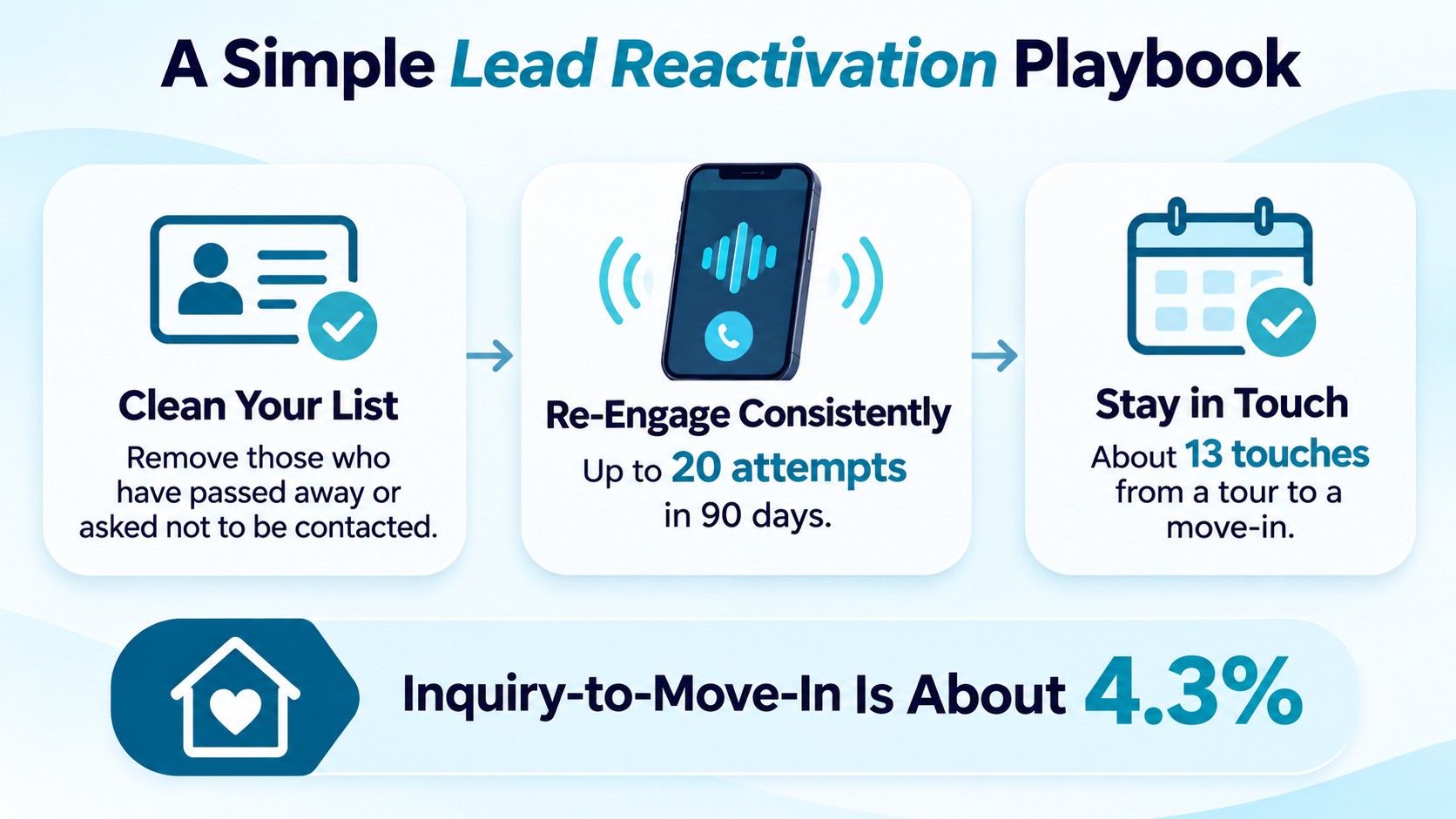
Clean the list first, then work it steadily.
What does a respectful sequence look like?
A respectful sequence is short and widely spaced, with an easy way to decline.
- A first call One open question about how the family is doing. No voicemail on the first attempt.
- A useful follow-up a few days later An invitation to an event or a short guide, sent by email or by text where you have consent.
- A second call after two weeks If the family engages, offer a visit. If not, leave a brief voicemail.
- A quarterly note after that Something worth reading, with no ask attached.
Compare that with new inquiries, where vendors now automate heavy persistence. Aline’s outbound product runs up to 20 attempts over 90 days. (Aline via PR Newswire) Older leads have not asked to hear from you this week, so the touch should be lighter.
What do you say?
Ask about the person before the apartment. This sample uses a made-up community and a counselor calling a daughter who toured five months ago.
Reactivation call, Sample script
Counselor: Hi Karen, this is Renee from Maple Court. You and your mother visited us in the spring. I’ve thought about you both and wanted to see how she is doing.
Family: Oh, hi Renee. She’s all right. Still at home.
Counselor: I’m glad to hear it. How has it been going for the two of you?
Family: Honestly, it’s getting harder. I’m over there most evenings.
Counselor: That is a lot to carry. Would it help to talk through options again, with no pressure either way?
Family: Maybe. She liked the garden at your place.
Counselor: She did. We’re hosting a lunch on the patio next Thursday. Would you both like to come as our guests?
The call offers company and a low-stakes next step. It does not mention pricing or deadlines.
How do you measure reactivation?
With a few numbers, tracked by segment and checked at three points in time.
| Metric | Definition |
|---|---|
| Reach rate | Families who answered or replied, divided by families attempted |
| Return to active | Leads moved back to an active stage, divided by leads attempted, at 30, 60, and 90 days |
| Tours | Visits booked from the campaign |
| Move-ins | Tracked for at least six months after the campaign |
| Opt-outs | Requests for no further contact, divided by leads attempted |
The 90-day view matters most. A family that re-engages in week two may tour in week eight. Add these to your regular sales KPIs so that reactivation is judged like any other lead source.
Start with a small list Book a demo to see how a reactivation campaign runs on a sample of older inquiries, and what your counselor receives. Book a demo
Should an AI agent make these calls?
An AI agent suits some segments and not others. The families your counselor toured deserve her voice. She remembers the garden.
The thousands of web inquiries that never spoke with anyone are a different matter. Nobody has time to call them all, and an AI agent can ask each one a single question: are you still looking for senior living for someone in your family? Those who say yes get a warm transfer or a scheduled call with a counselor. Used that way, the technology finds the conversations and people have them. For the questions that follow, see our first inquiry call script, and for the top of the funnel, our inquiry-to-tour benchmarks.
Some families are ready now Try VerbaCall free with 30 minutes of call time, or book a demo to hear a gentle check-in call. Book a demo or Try for free
Frequently asked questions
How many lost leads come back?
We have not found a public benchmark we trust, so we will not quote one. Build your own baseline. Run a first campaign on a few hundred records and track how many return to active status at 30, 60, and 90 days.
How long should we wait before re-contacting a lost lead?
It depends on the reason. A family that said “not yet” can hear from you in 60 to 90 days. One that chose another community should be left alone for at least six months, and then contacted once.
Is it appropriate to call families who chose another community?
A single, courteous check-in after several months is reasonable. Some moves do not work out. Do not criticize the other community, and take a no as final.
Should a counselor or an AI agent make reactivation calls?
Counselors should call families they toured or spoke with at length. An AI agent suits older web inquiries that never connected with anyone, where the job is to ask whether the family is still looking and to offer a conversation.
What if the prospect has passed away?
Mark the record and remove it from all outreach permanently. Check your CRM for notes before each campaign. A call to a grieving family about a move is the mistake this whole process must prevent.
Sources
- Aline via PR Newswire, May 2026. Aline Launches Aline Connect
- MatrixCare and Aline, August 2026. Executive brief citing Aline’s Annual Benchmark Report 2026
- WelcomeHome Senior Care Insights, 2026. 2025 Year in Review
- Federal Communications Commission, February 2024. FCC Confirms TCPA Applies to AI Technologies That Generate Human Voices
About VerbaCall. VerbaCall is an AI voice agent platform. It calls new leads within about 20 seconds, answers inbound calls at any hour, books appointments, and warm-transfers ready callers to your team. Each conversation is written back to your CRM, with text and email follow-up alongside. It is built on Twilio and serves US businesses in real estate, senior living, home care, healthcare, and restaurants. See VerbaCall for senior living.